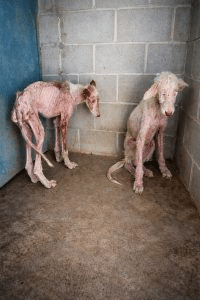
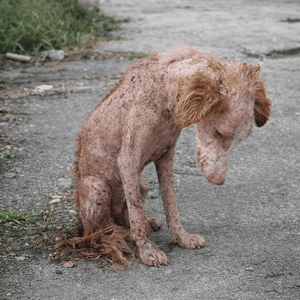
For a long time, a white-and-gray dog could be seen wandering slowly around an industrial area, never traveling far from an old factory.
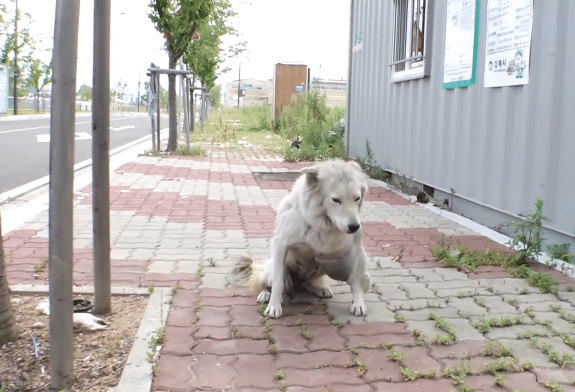
At first, people might have noticed only his unusual walk. His steps were cautious and uneven, and he frequently stopped to rest.
A closer look revealed why.
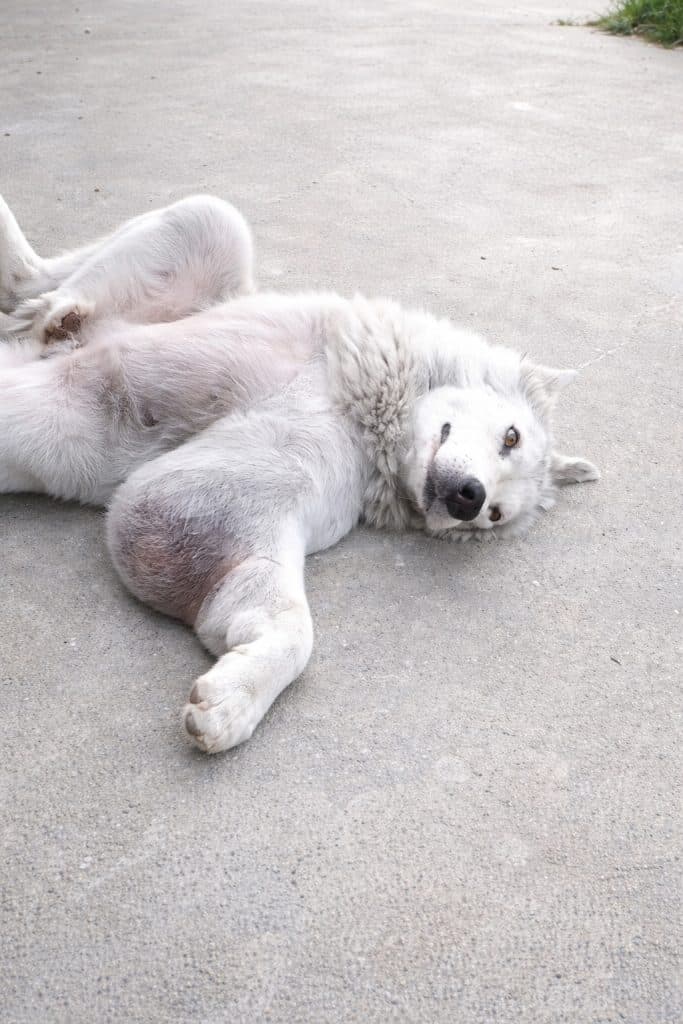
A remarkably large mass had developed around his abdomen and rear leg, adding considerable weight to his body and making ordinary movement increasingly difficult.
Still, the dog remained near the same factory grounds day after day.
He had adapted to a life that had become harder with time. Fortunately, people in the area noticed him, and eventually the attention of rescuers and veterinary professionals gave him an opportunity to leave that difficult chapter behind.
Video Abandoned Outside a Factory With a Massive Tumor This Loyal Dog Waited Until Someone Finally Helped
A Familiar Dog Around an Abandoned Factory
Workers in the area already knew the dog.
One woman regularly provided food whenever she could. According to her account, she had noticed the swelling much earlier, when it was considerably smaller.
Over time, the mass continued growing.
As it became larger, the dog’s mobility became increasingly limited. Walking required more effort, and frequent rest became part of his routine.
Another local worker provided background about why the dog remained so close to the industrial property.
According to the account, he had once belonged to the manager of a factory in the area. When the business closed, the manager left, but the dog remained behind.
Whether the dog stayed because the surroundings were familiar or for another reason cannot be known with certainty.
What was obvious was that he rarely traveled far.
The old factory had become the center of his world.
Veterinary Help Finally Arrives
Eventually, rescuers arrived with a veterinarian to evaluate the dog.
This was an important turning point because the size of a growth cannot reveal its exact nature simply by appearance.
The veterinarian examined the dog’s general condition and carefully assessed the mass.
According to the rescue account, its location was affecting important structures around the leg, helping explain why movement had become so difficult.
The dog needed more comprehensive diagnostic testing before anyone could determine the safest treatment plan.
Rescuers carefully placed him in a transport crate and brought him to a veterinary hospital.
For the first time, the problem that had been growing for so long was being investigated by professionals who could potentially do something about it.
Diagnostic Tests Provide Important Answers
At the hospital, veterinarians performed a series of examinations.
The account describes ultrasound imaging, X-rays, blood testing, and microscopic analysis as part of the diagnostic process.
These tests were essential.
A visible lump or mass in an animal can have many possible causes. Appearance alone cannot reliably determine whether a growth is benign or malignant, nor can it show veterinarians everything happening beneath the surface.
For this dog, the findings reportedly raised significant concern that the tumor could be malignant.
That possibility changed the conversation.
The veterinary team now had to consider not only the dog’s current mobility but also the potential consequences of leaving the growth untreated.
After reviewing the available information, the team recommended major surgery.
A Difficult Decision Offers the Best Chance Forward
Removing the tumor would not be a simple procedure.
According to the account, the growth had extensively affected the tissue around one rear leg.
Veterinarians concluded that removing the affected leg together with the mass offered the most appropriate path forward.
It was a major decision.
Amputation can sound frightening, especially to people unfamiliar with how animals adapt afterward. Yet when a limb is severely compromised by disease or another serious medical problem, veterinarians may recommend removal when preserving it is no longer considered the best option for the animal’s welfare.
In this case, the goal was straightforward: remove the enormous physical burden and give the dog a better opportunity for comfortable movement and continued care.
The medical team prepared him for surgery.
After spending so much time carrying the mass, the dog was finally approaching the moment when it could be removed.
Surgery Removes the Enormous Burden
The procedure was complex, but according to the rescue story, it was successfully completed.
Veterinarians removed the tumor along with the affected rear leg.
After surgery, the dog entered a closely monitored recovery period. He received supportive care, including intravenous fluids, while the veterinary team watched his condition.
Recovery could not be rushed.
His body had undergone a major procedure, and adapting to three legs would require time.
Yet one enormous difference was already visible.
The heavy mass that had made every walk more difficult was gone.
The woman who had regularly fed him reportedly visited during his hospital recovery.
Seeing the familiar dog after such a significant operation was understandably emotional.
But his changed appearance also represented something hopeful.
The procedure had given him a chance to move forward without carrying the same burden.
Learning to Navigate Life on Three Legs
Removing a leg changes how a dog balances and distributes weight.
The animal must learn to adjust its movement, particularly during the early recovery period.
That process is not about expecting instant perfection.
It is about gradual adaptation.
At first, standing and walking may feel unfamiliar. The remaining limbs take on different responsibilities, and the dog must develop a new sense of balance.
With appropriate veterinary guidance and recovery support, many dogs can adapt remarkably well to three-legged mobility.
This dog began making that adjustment.
The same animal who had previously struggled beneath the weight of a large mass eventually appeared walking on three legs.
His movement looked different, but he was moving forward.
That was the point.
Losing a limb did not define the rest of his life.
Instead, surgery created an opportunity for a life no longer dominated by the enormous growth.
Follow-Up Care Remains Important
Successful surgery was a major milestone, but it did not automatically end the dog’s medical journey.
The rescue account notes that follow-up checks would still be necessary.
That is especially important when veterinarians have concerns about a potentially malignant tumor.
Ongoing veterinary monitoring can help professionals evaluate recovery, watch for changes, and determine whether additional care is appropriate.
The source story does not establish the dog’s complete long-term medical outcome, so it would be inappropriate to claim that surgery permanently eliminated every future health concern.
What it does show is an encouraging improvement in his immediate quality of life.
He had been given professional treatment.
The massive growth was removed.
He received recovery support.
And he began learning to move comfortably on three legs.
Those are meaningful steps forward.
Why Unusual Lumps Should Never Be Ignored
The dog’s experience also offers a practical reminder for pet owners.
Not every lump is dangerous, but unusual or changing growths deserve professional veterinary attention.
Waiting for a mass to become extremely large can make treatment more complicated.
A veterinarian can examine a growth and determine whether diagnostic testing is appropriate. Depending on the individual case, this might involve imaging, laboratory testing, tissue sampling, or other procedures.
Early evaluation does not guarantee a particular outcome, but it provides information.
And information gives veterinary professionals more opportunity to make informed decisions.
If you notice a new lump on a pet, particularly one that grows, changes shape, affects movement, or appears to cause discomfort, scheduling a veterinary examination is a responsible next step.
The lesson is simple: noticing something unusual is valuable, but acting on that observation matters even more.
A Loyal Dog Finally Steps Into a Different Life
Perhaps the most memorable part of the story appears near the end.
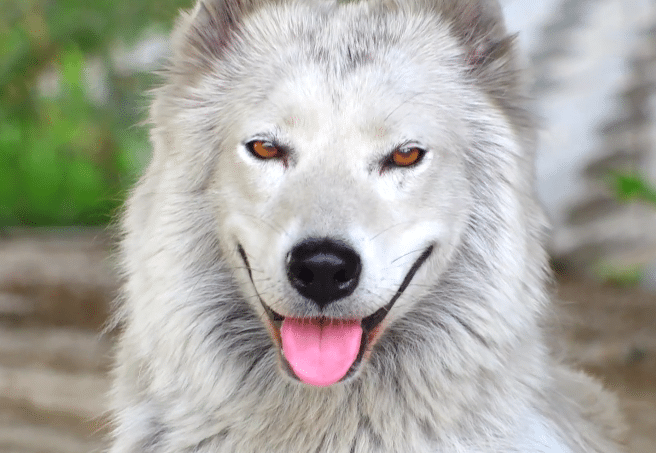
The dog who had once moved slowly around the factory grounds is shown walking on three legs.
He wears a small warm sweater as he explores his surroundings.
His body looks dramatically different without the enormous mass.
The contrast is striking, but the real transformation is not cosmetic.
He can move without carrying the same physical weight.
For so long, his world had centered on an abandoned industrial area and a condition that made every journey more difficult.
Now his circumstances had changed.
His future would still require responsible care and veterinary monitoring, but he had already crossed an important bridge.
He was no longer simply enduring the problem.
He was recovering from it.
Compassion Becomes Most Powerful When It Leads to Action
Several people contributed to this dog’s second chance.
Local workers noticed him.
One woman continued feeding him.
Rescuers became involved.
Veterinary professionals examined him, performed diagnostic testing, developed a treatment plan, completed surgery, and supported his recovery.
No single moment tells the whole story.
Compassion works like a chain of small decisions.
Someone notices.
Someone provides food.
Someone makes a call.
Someone arranges transportation.
Someone provides professional medical care.
Together, those actions can completely change an animal’s future.
This dog did not need exaggerated promises or a perfect ending.
He needed people willing to respond to what was directly in front of them.
And eventually, that help arrived.
Summary
A white-and-gray stray dog had been living around an industrial area while carrying an unusually large mass near his abdomen and rear leg. The growth became increasingly burdensome, making walking difficult and forcing him to rest frequently.
Local workers knew the dog, and one woman regularly provided food. According to their account, he had once belonged to a factory manager but remained near the property after the business closed.
When rescuers and a veterinarian became involved, the dog was transported to a veterinary hospital for a comprehensive examination. Diagnostic testing reportedly raised concerns that the tumor could be malignant and showed that the affected rear leg could not reasonably be preserved as part of the recommended treatment.
Veterinarians therefore performed surgery to remove the mass along with the affected leg.
The operation was reported as successful, and the dog began recovering under professional supervision. He then faced another challenge: adapting to life on three legs.
Gradually, he learned to move differently.
Later scenes showed him walking on three legs and exploring his surroundings without the enormous mass that had previously made every step difficult.
His long-term health would still require appropriate veterinary monitoring, but his immediate transformation demonstrates what timely professional care can accomplish.
The dog once remained near an old factory carrying a burden he could not escape on his own.
Then people noticed, acted, and gave him another path.
Sometimes a second chance does not mean returning life to exactly what it was before.
Sometimes it means helping an animal move forward comfortably, confidently, and with far less weight to carry.