The first thing you hear isn’t silence. It’s a bark.
Short. Sharp. Intentional.
It cuts through the stillness of the forest like a signal flare. Not frantic. Not desperate. Just clear. Purposeful. A message that says, “Hey. I need you.”
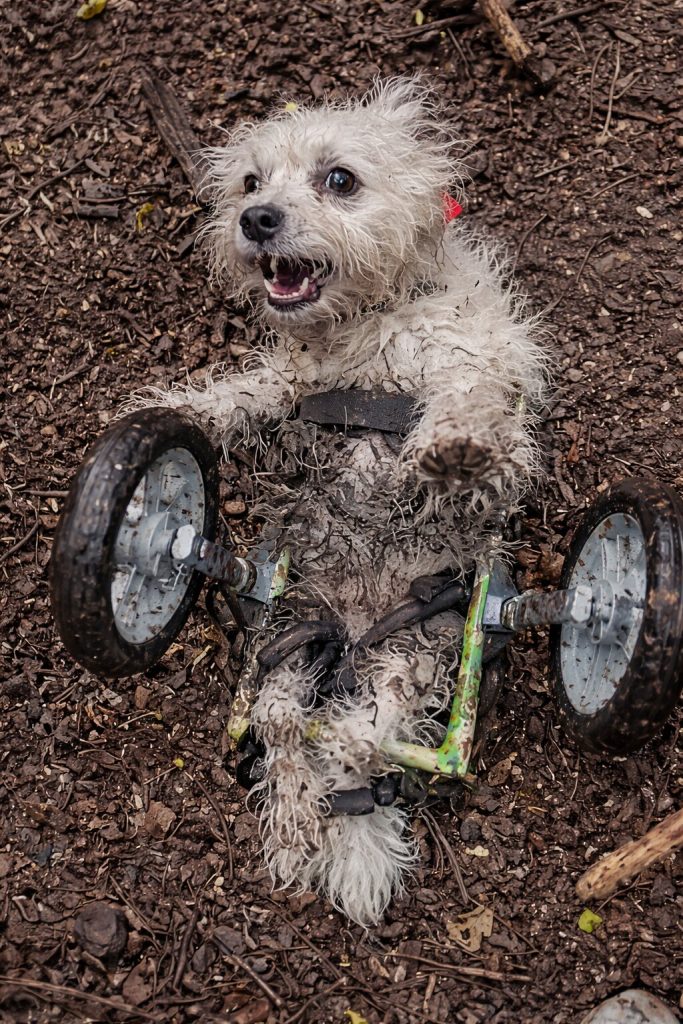
That bark belongs to Jack—a small West Highland White Terrier with paralyzed back legs and a spirit that refuses to shrink. And if you think a wheelchair slows him down, you haven’t seen him on a trail.
Because Jack doesn’t roll through the woods carefully.
He charges.
Video When Jack Barks for Help, It’s Never “Just Barking”
A Body That Moves Differently—But Moves Anyway
Jack’s back legs don’t work. They never will. But here’s the thing: the forest doesn’t check medical records before it calls your name.
And it calls Jack every single day.
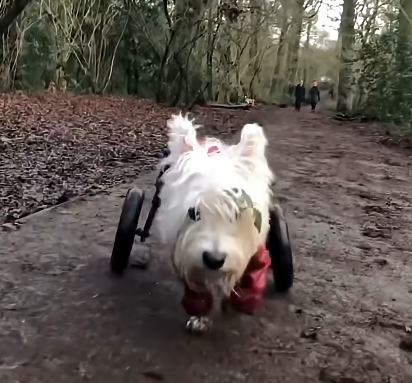
With the help of a custom dog wheelchair, he navigates dirt paths, wooded trails, and uneven terrain with astonishing confidence. Roots jut out of the earth. Small dips hide beneath fallen leaves. Gravel shifts under spinning wheels. It’s not a smooth ride.
But Jack doesn’t hesitate.
He leans forward into his harness, front paws pumping, wheels humming behind him. Nose low. Ears alert. Every scent is an invitation. Every bend in the path is a promise.
He moves like a dog who believes he belongs out there.
Because he does.
When the Trail Fights Back
Let’s be honest. Trails aren’t always kind to wheels.
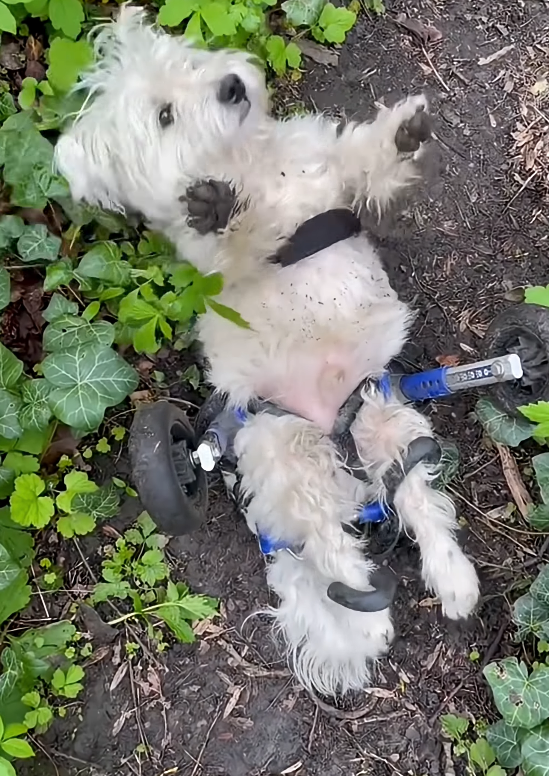
A hidden root can stop him cold. A sharp angle can tip his balance. One wrong turn on uneven ground—and suddenly Jack is flipped onto his side, wheels spinning in the air.
It happens fast.
In that moment, he can’t right himself. He can’t push back upright. He can’t roll forward or backward.
So he does the one thing he can do.
He barks.
But here’s what makes it powerful: it’s not a bark of fear. It’s not chaos. It’s communication.
Jack knows someone is listening.
A Bark Meant for One Person
Jack doesn’t bark randomly. He doesn’t call out to the whole world.
He calls for her.
The woman he clearly sees as his safe place. His person. The one who understands that this bark means, “I’m tipped. I need a hand.”
There’s no panic in his eyes when he waits. No shaking. No despair.
There’s certainty.
He knows she will come.
And she does.
Every time.
She runs toward the sound, kneels down, and gently lifts him back upright. She checks the wheels. She adjusts the harness. Sometimes she brushes dirt off his white fur.
The entire rescue takes seconds.
Then something incredible happens.
He bolts.
No Drama. Just Forward
The second his wheels hit the ground, Jack is off.
No hesitation. No sulking. No “maybe I should take it easy now.”
He doesn’t replay the fall in his mind. He doesn’t reduce his speed. He doesn’t decide the trail is too dangerous.
He just… keeps going.
If resilience had a soundtrack, it might sound like the whir of small wheels spinning against packed earth.
A Wheelchair Isn’t a Limitation—It’s an Upgrade
We tend to look at assistive devices and think of them as symbols of loss. Something that compensates for what’s missing.
But watch Jack for five minutes, and your perspective shifts.
His wheelchair isn’t a reminder of what he can’t do.
It’s the reason he can do so much.
Without it, the forest would be a distant memory. With it, it’s his playground.
He races past tree trunks. He splashes through shallow puddles. He noses into bushes like any curious terrier would. Birds scatter as he zooms by. Leaves crunch beneath determined paws.
If you didn’t know his back legs were paralyzed, you’d simply see a dog having the time of his life.
And maybe that’s the point.
Trust Makes Adventure Possible
Here’s something else this story reveals: resilience doesn’t grow in isolation.
Jack’s confidence comes from knowing he’s supported.
He explores boldly because he trusts someone has his back. Literally.
That bark? It’s not weakness. It’s partnership.
It says, “I’ll do my part. And I know you’ll do yours.”
In a world where independence is often glorified, Jack shows us something better: interdependence. The kind of relationship where strength and support exist side by side.
He doesn’t pretend he can flip himself over.
He doesn’t need to.
He knows help will come.
And that knowledge frees him to live fully.
Redefining What “Normal” Looks Like
Jack doesn’t see himself as a “disabled dog.” That label belongs to human language, not to him.
He sees trails. Smells. Sounds. Movement.
He sees the next corner.
His body moves differently, yes. But difference isn’t deficiency.
In fact, his presence on those trails challenges something subtle inside all of us. We often assume that physical limits automatically shrink joy.
Jack proves otherwise.
Joy isn’t measured in symmetry. It’s measured in engagement.
And he is fully engaged.
Every run through the woods feels like a celebration. Every successful turn feels like a victory. Even every flip—followed by that determined bark—feels like part of the adventure.
Lessons from a Little Dog on Wheels
What does Jack teach us?
First, that courage doesn’t always roar. Sometimes it barks.
Second, that asking for help isn’t failure. It’s strategy.
And third, that the story doesn’t end where ability changes.
It simply changes shape.
Jack could have lived a small life. Indoors. Safe. Predictable.
Instead, he lives a wide one.
He tips over. He gets back up. He tips again. He keeps exploring.
He doesn’t shrink his world to match his limits.
He expands it to match his spirit.
Rolling Toward What’s Next
The video that captures Jack’s adventures doesn’t rely on dramatic music or emotional narration. It doesn’t need to.
All you hear is the bark.
The wheels.
The rustle of leaves.
And the steady footsteps of someone who always comes when called.
That’s enough.
Because in that simple rhythm—bark, lift, run—there’s something deeply human.
We all fall. We all get stuck. We all need someone who hears our signal and shows up.
And if we’re lucky, we get to roll forward again.
Summary
Jack, a Westie with paralyzed back legs, explores forest trails using a custom wheelchair that allows him to live boldly and freely. When uneven terrain causes him to tip over, he barks—not in panic, but as a clear signal to his trusted caregiver. She quickly helps him back onto his wheels, and without hesitation, he continues his adventure. Jack’s story isn’t about limitation; it’s about resilience, trust, and the power of support. His wheelchair enables possibility, not restriction, and his determined spirit reminds us that strength often sounds like a bark and looks like a small dog racing forward without fear.






