A black stray dog wandered across a dry, rocky hillside, struggling to find his way through the uneven terrain. From a distance, he looked like an ordinary street dog searching for food or a safe place to rest.
But something was terribly wrong.
A large transparent plastic container had become stuck around his head and neck, blocking his vision and making every movement difficult.
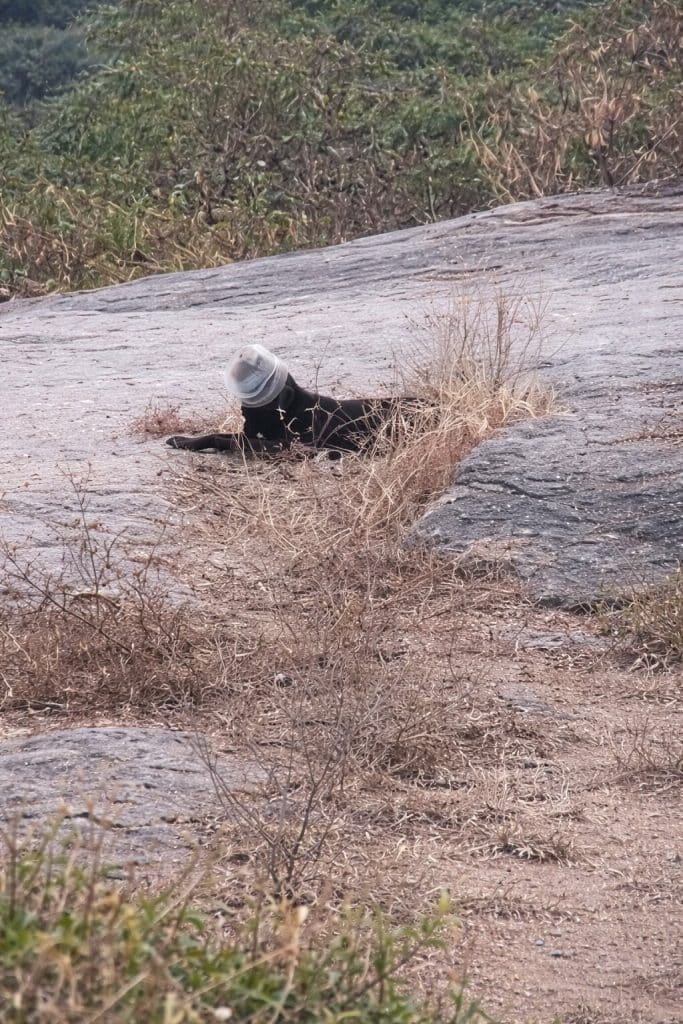
He could not remove it himself.
With loose stones covering the hillside and no clear path ahead, the frightened dog faced an increasingly dangerous situation.
Fortunately, reports of his condition reached the Animal Warriors Conservation Society (AWCS), an animal rescue organization whose team set out to find him.
What followed was a challenging rescue that demonstrated how patience, teamwork, and simple equipment can make an extraordinary difference in an animal’s life.
Video His Entire Head Was Trapped Inside a Plastic Jar Then He Ran Blindly Across the Rocks
A Stray Dog Struggles With a Plastic Container
The dog’s difficulties began when a large plastic jar became lodged around his head.
The exact circumstances were unknown, but discarded food containers can attract stray animals searching for something to eat.
A dog may push its head into a container to investigate an unfamiliar smell, only to discover that removing it is much harder.
For this black dog, the jar had become firmly stuck.
The transparent material partially obstructed his vision, while the narrow opening around his neck prevented him from pulling free.
Even ordinary activities had become challenging.
Walking across rough ground required greater caution.
Finding food or drinking water would have been difficult while the container remained in place.
The longer the dog remained trapped, the greater the potential risks to his health and safety.
He needed help, but reaching him would not be easy.
Rescuers Begin Searching the Rocky Hillside
After learning about the dog’s condition, rescuers from AWCS traveled to the area where he had reportedly been seen.
The surrounding landscape presented an immediate challenge.
Dry earth, scattered rocks, and uneven slopes made movement difficult for both the animal and the rescue team.
The dog was already frightened and disoriented.
Approaching too quickly could cause him to run farther into the hillside, making the situation even more complicated.
The rescuers understood that they needed a careful strategy.
They moved slowly, watched his behavior, and attempted to reduce unnecessary disturbance.
Their goal was to get close enough to secure him without increasing his risk of injury.
However, the dog noticed their presence before they could reach him.
A Frightened Dog Runs Across the Rocks
As the rescuers approached, the dog suddenly ran.
His reaction was understandable.
He was unfamiliar with the people moving toward him, and the container around his head made it harder to understand what was happening.
He hurried across the rocky terrain, attempting to escape.
But his obstructed vision made the journey difficult.
His steps were awkward, and he struggled to navigate the loose stones.
The rescuers followed carefully, aware that allowing him to disappear into the surrounding landscape could make finding him again extremely difficult.
At the same time, they needed to avoid creating additional panic.
Instead of relying on force, the team prepared equipment designed to help them contain the dog safely.
A large rescue net became an essential part of their plan.
A Safety Net Helps Bring the Dog Under Control
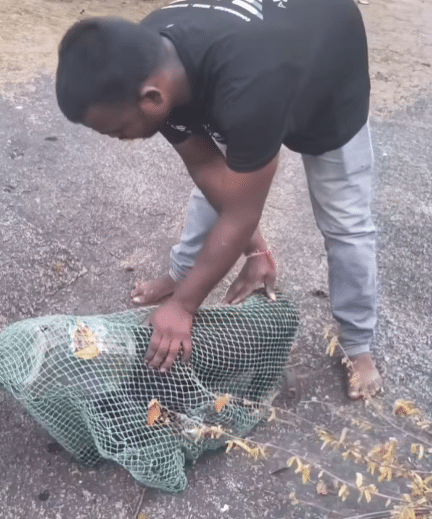
After several challenging moments, the rescue team managed to guide the dog into a large safety net.
The equipment helped prevent him from running farther across the hillside while allowing the rescuers to control his movements.
Once secured, the dog remained tense and frightened.
The team approached carefully, understanding that an unfamiliar animal may struggle when restrained.
Their priority was to keep him as calm and stable as possible while examining the container.
Now that they could see the problem clearly, they realized that removing the jar would require more than simply pulling it off.
The plastic opening had become tightly lodged around his head and neck.
Trying to remove it by force could cause additional discomfort or injury.
The rescuers needed a safer solution.
They decided to cut the container apart.

Careful Cutting Becomes the Key to Freedom
With the dog secured, the team prepared their cutting tools.
One rescuer helped keep him steady while another began carefully working on the plastic.
The process required concentration.
The container was close to the dog’s face and neck, so every movement needed to be controlled.
Rather than attempting to break the jar in one motion, the rescuers worked gradually.
They cut through small sections of plastic, weakening the material and widening the opening.
The dog remained restrained while the team continued.
Although the task appeared straightforward, it required patience and coordination.
A sudden movement could make the work more difficult.
The rescuers therefore focused on maintaining control while carefully separating the plastic from the animal.
Little by little, the container began to loosen.
The Moment the Plastic Jar Finally Comes Off
After the rescuers cut through enough of the plastic, the container finally released.
The jar came free from the dog’s head.
For the first time since the team had found him, his face was completely uncovered.
The object that had obstructed his vision and restricted his movement was no longer attached to him.
The rescuers paused briefly to ensure that the container had been removed successfully.
The dog could now lift his head without the large plastic barrier surrounding it.
He could see the rocky ground in front of him.
Most importantly, he no longer faced the immediate difficulties created by the trapped container.
The rescue had reached its most important milestone.
But the team still needed to release him safely.
A Remarkable Return to Freedom
Once the rescuers determined that the dog could be released, they allowed him to move away.
He immediately headed toward the open hillside.
Then he began running.
The difference was noticeable.
Earlier, his movements had been uncertain because the container interfered with his ability to navigate.
Now he moved more confidently across the uneven ground.
He continued toward the nearby forest and soon disappeared among the trees.
There was no elaborate celebration.
The dog did not remain beside the rescuers or pose for photographs.
He simply returned to his surroundings.
For the team, that was a meaningful outcome.
Their immediate objective had been to locate the dog, remove the dangerous obstruction, and restore his ability to move freely.
They had accomplished that goal.
Why Discarded Plastic Containers Can Endanger Animals
This rescue highlights a common but preventable environmental hazard.
Plastic containers are ordinary household objects, yet they can become dangerous when people discard them carelessly.
Food residue may attract stray dogs, cats, and wildlife.
Animals searching for something to eat may investigate jars, bottles, or other packaging with narrow openings.
If an animal pushes its head inside, the container may become trapped.
Depending on the shape and size, it can interfere with normal movement, feeding, drinking, or breathing.
Even when the material is transparent, it may distort vision and make navigation difficult.
The problem can become especially serious in outdoor environments where uneven ground, traffic, or unfamiliar obstacles create additional hazards.
For this black dog, a discarded plastic jar turned an ordinary hillside into a difficult landscape.
Fortunately, trained rescuers were able to intervene.
Small Actions Can Help Prevent Similar Incidents
Responsible waste disposal plays an important role in protecting animals.
People can reduce potential hazards by securing household rubbish and placing discarded packaging in appropriate collection containers.
When safe and suitable for local recycling requirements, empty containers can be prepared in ways that reduce the likelihood of animals becoming trapped.
Food waste should also be disposed of responsibly.
These everyday habits may seem insignificant, but they help reduce the amount of potentially dangerous litter in public spaces.
Communities can also support local cleanup efforts and report animals in distress to appropriate rescue organizations.
The goal is not simply to respond after an incident occurs.
It is to reduce preventable risks before animals encounter them.
Why Professional Animal Rescue Matters
An unfamiliar dog with a container stuck around its head may appear to need a simple intervention.
However, approaching a frightened animal can be complicated.
The dog may panic, run into traffic, or move toward hazardous terrain.
Attempting to pull off a tightly lodged object can also cause injury.
That is why contacting experienced rescuers or animal welfare professionals is often the safest option.
The AWCS team’s response demonstrated the importance of preparation.
They assessed the terrain.
They approached cautiously.
They used appropriate equipment to contain the dog.
They removed the container gradually rather than forcing it off.
Their coordinated efforts helped resolve a difficult situation.
A Rescue With a Simple but Powerful Ending
Some animal rescue stories involve lengthy veterinary treatment, rehabilitation, and adoption.
Others have a more immediate goal.
This dog’s rescue belonged to the second category.
He did not need to learn how to live in a new home during the events described.
He needed someone to remove the object that had become trapped around his head.
Once the container was gone, he could return to moving through his surroundings without that obstruction.
The account does not describe a later veterinary examination or long-term follow-up, so his subsequent health cannot be confirmed from the rescue footage alone.
What it does show is an important improvement.
The dog who had struggled across the hillside with a plastic jar covering his head was able to run away without it.
That moment captured the purpose of the entire rescue.
Summary
A black stray dog was discovered struggling across a rocky hillside with a large transparent plastic container stuck around his head and neck.
The container obstructed his vision and made it difficult to navigate the uneven terrain.
After receiving reports about the animal, rescuers from the Animal Warriors Conservation Society traveled to the area to help.
The frightened dog initially ran away, forcing the team to follow him carefully across the rocks.
Using a large safety net, the rescuers eventually secured him and examined the trapped container.
Because the plastic was too tightly lodged to remove safely by pulling, they used cutting tools to gradually separate it.
After careful work, the jar finally came free.
The dog could once again move without the container obstructing his vision.
When released, he ran across the hillside and disappeared into the nearby forest.
His rescue illustrates the importance of responsible waste disposal, community awareness, and trained animal rescue teams.
An ordinary piece of discarded plastic had created a serious problem for a vulnerable animal.
Fortunately, someone noticed, and experienced rescuers responded.
The most meaningful moment came at the end, when the black dog ran freely across the rocks.
Sometimes a successful rescue does not end with an animal entering a new home.
Sometimes it ends with a dog simply being able to see the path ahead again.






