Some sounds don’t demand attention.
They don’t echo loudly. They don’t force you to stop.
They simply linger—soft, steady, and impossible to forget once you hear them.
That’s how this story begins.

On the side of a quiet road, where most people pass without looking twice, a faint cry broke through the silence. It wasn’t aggressive. It wasn’t frantic.
It was persistent.
And sometimes, persistence is what makes the difference.
Video He Cried and Begged Not for Himself, But to Save His Brother
A moment that revealed something deeper
When the camera moved closer, the scene became clear.
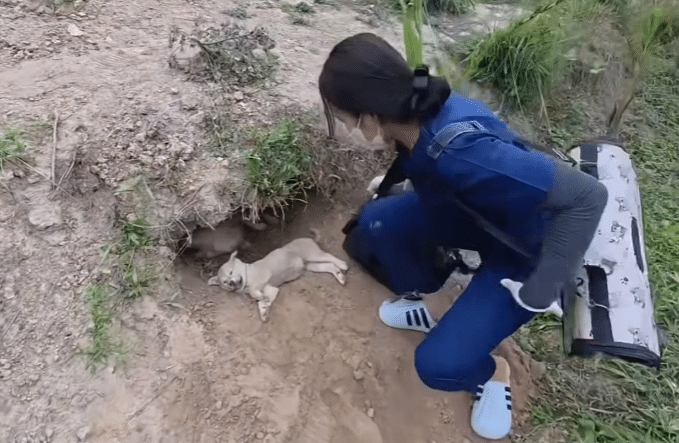
Two tiny puppies.
One standing.
One lying still.
They were siblings—close in size, close in presence, but separated by something more serious than distance.
The standing puppy trembled slightly, his body thin and unsteady. His ribs showed beneath his fur, a quiet sign of how long he had gone without proper nourishment. Yet he wasn’t focused on himself.
He nudged the puppy beside him.
He whimpered.
He looked up—toward the person holding the camera—as if trying to communicate something urgent.
Not fear.
Not confusion.
But a request.
A life that asked for help, not for itself
There is something profoundly moving about selflessness, especially when it comes from a place where survival is uncertain.
The standing puppy was clearly hungry. His body showed it. His movements reflected it.
But even in that state, his attention remained fixed on his sibling.
He didn’t wander away.
He didn’t search for food elsewhere.
He stayed.
Close.
Present.
And that decision—simple as it may seem—changed everything.
Because when help arrived, he didn’t react the way you might expect.
He didn’t run.
He didn’t hide.
He stayed exactly where he was.
And continued to look back at his brother.
When someone chose to step closer
The person behind the camera made a choice.
Not to observe from a distance.
Not to walk away.
But to step forward.
Carefully.
Because in moments like this, how you approach matters just as much as the fact that you do.
There were no sudden movements. No loud sounds. Just a calm presence that allowed the situation to unfold without adding fear.
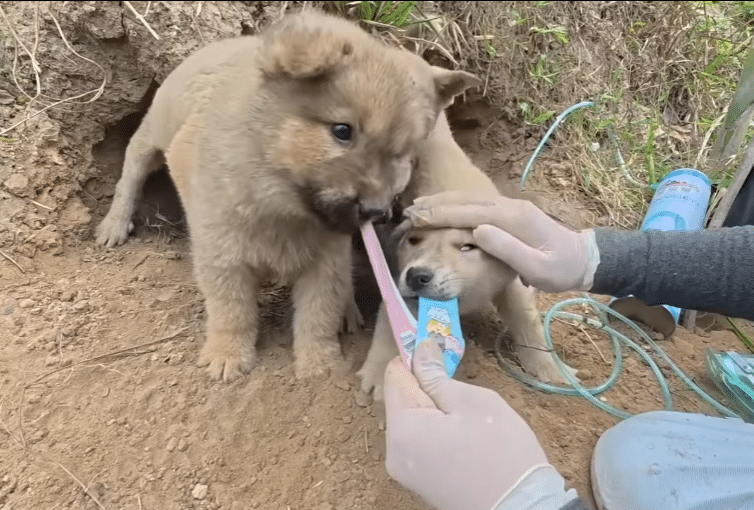
Food and water were brought.
Gently.
The standing puppy hesitated for a brief moment, as if weighing instinct against caution. Then hunger took over. He began to eat—but even then, something remarkable happened.
He kept turning back.
Checking.
Watching.
As if saying, “Don’t forget him.”
A quiet communication that needed no words
Animals don’t speak in sentences.
They don’t explain their needs in ways we are used to.
But they communicate clearly—through actions, through presence, through attention.
This puppy’s message was unmistakable.
Help him too.
And that message was heard.
The weaker sibling was offered water, carefully and patiently. Small amounts of food followed, introduced slowly to avoid overwhelming a fragile system.
There was no rush.
No expectation of immediate change.
Just steady, thoughtful care.
And slowly, something shifted.
The first signs of stabilization
At first, the changes were subtle.
A slight movement.
A faint response.
Breathing that became more regular.
The kind of progress that is easy to overlook if you’re expecting something dramatic—but deeply meaningful if you understand what it represents.
Stability.
A return, however small, toward balance.
The standing puppy noticed too.
His cries softened.
His body relaxed slightly.
And yet, he remained close.
Because connection doesn’t disappear just because conditions improve.
In fact, it often becomes stronger.
More than a rescue—something deeper
What makes this story stay with you is not just the act of helping.
It’s the reason help was given.
Yes, someone brought food.
Yes, someone offered water.
But what triggered that response?
It wasn’t urgency alone.
It was loyalty.
The standing puppy didn’t demand attention for himself.
He directed it toward another.
And that kind of instinct—quiet, steady, and focused—is powerful.
It reminds us that connection exists even in the most difficult conditions.
Even when resources are limited.
Even when strength is fading.
A bond that refuses to break
Siblings share something unique.
A familiarity.
A closeness that doesn’t require explanation.
For these two puppies, that bond remained intact despite everything they had experienced.
One stayed when leaving would have been easier.
One called out when silence would have gone unnoticed.
And because of that, both had a chance.
Not a guaranteed outcome.
But a chance.
And sometimes, that is enough.
Why small moments matter more than we think
It’s easy to assume that meaningful change requires something large.
A coordinated effort.
A complex plan.
A dramatic intervention.
But often, it begins with something much smaller.
A sound.
A pause.
A decision to move closer instead of continuing on.
In this case, the difference between two possible outcomes came down to one moment of attention.
Someone heard something.
And chose to respond.
What this teaches us about awareness and care
How many moments pass us by each day that we never notice?
How many quiet signals go unheard because they don’t interrupt us strongly enough?
This story invites us to reconsider that.
To slow down.
To listen more carefully.
To recognize that not all needs are expressed loudly.
Sometimes, they are whispered.
And sometimes, those whispers carry the most meaning.
Because they reveal not just a need for survival—but a desire to protect, to connect, to care.
A different ending, because someone chose to act
By the end of the moment, both puppies were in a better state.
Not fully recovered.
Not completely safe.
But no longer alone.
Their breathing steadied.
Their bodies relaxed.
And the space around them changed—from isolation to support.
And that change matters.
Because it shows what is possible when awareness meets action.
When attention leads to care.
And when care is guided not just by urgency—but by understanding.
Summary
This article tells the story of two small puppies found on the roadside, where one stood weakly beside a sibling in critical condition. Despite his own hunger, the standing puppy focused on seeking help for his brother, repeatedly drawing attention to him. A passerby chose to intervene, offering food and water carefully and allowing both puppies to begin stabilizing. The story highlights the power of loyalty, connection, and awareness, showing how a simple decision to respond to a quiet cry can change the course of two lives.






