On a quiet country road, a pregnant stray dog lay exhausted, far from the safety and comfort she desperately needed. Her body appeared weak, and her distant gaze suggested that she had been struggling for some time.
There was no familiar home nearby, no sheltered resting place, and no one immediately attending to her needs.
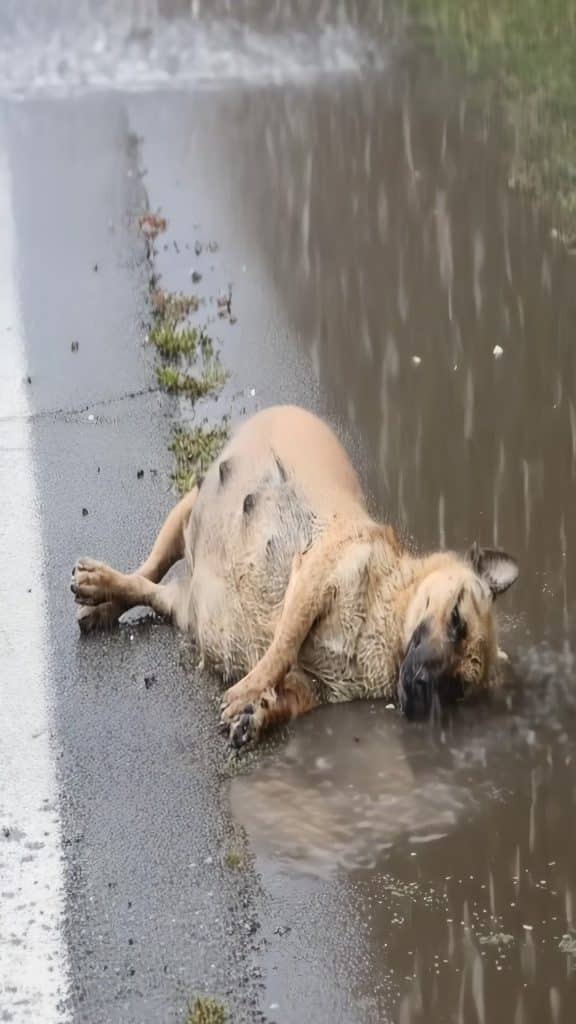
Fortunately, someone noticed her condition and contacted rescuers.
When the rescue team arrived, however, the dog had disappeared. Only faint paw prints remained, leading away from the roadside and into the surrounding land.
Video Found Alone While Pregnant, She Disappeared Into the Unknown Until Hope Found Her Again
What followed was a determined search that continued for days.
When volunteers finally located her again, she was no longer pregnant. She appeared thinner, moved slowly, and remained cautious around unfamiliar people.
Her experience had clearly been difficult, but the rescuers were determined to give her a chance to recover.
Through patient handling, appropriate care, and a gradual return to trust, this vulnerable dog eventually began eating, accepting affection, and walking confidently on a leash.
Her journey offers a meaningful reminder that animal rescue often requires persistence long after the first call for help.
A Pregnant Dog Discovered on a Quiet Country Road
The first report described a pregnant female dog lying near a rural road.
She appeared exhausted and vulnerable, with no obvious shelter or caregiver nearby.
Pregnancy can increase a dog’s nutritional and physical needs, particularly during its later stages. For an animal living outdoors, finding adequate food, clean water, and a protected resting place may become increasingly difficult.
The dog’s condition concerned the person who discovered her.
Rather than leaving her unnoticed, the individual contacted rescuers and requested assistance.
The report provided the team with a starting location, but the situation changed before they could reach her.
By the time volunteers arrived, the dog was gone.
A Rescue Begins With an Unexpected Disappearance
The rescuers searched the area where the pregnant dog had last been seen.
They found no sign of her resting nearby.
Instead, faint paw prints appeared to lead away from the road and into the surrounding land.
The team could not determine exactly why she had moved.
She may have been searching for shelter, food, or a quieter location. The available account does not establish her intentions.
What mattered was that an exhausted pregnant animal remained somewhere outdoors without confirmed access to care.
The volunteers decided to continue looking.
A rescue that had initially seemed straightforward became a search across an unfamiliar rural environment.
They would need patience, repeated visits, and careful observation to locate her.
Days of Searching Through Roads and Open Fields
For several days, volunteers returned to the surrounding area.
They checked quiet roads, open fields, and secluded corners where a stray dog might seek temporary shelter.
They also called gently, hoping to attract her attention without frightening her.
Each visit brought uncertainty.
The dog could have traveled farther than expected, and her condition might have changed since the original sighting.
Searching for a frightened animal can be challenging because unfamiliar voices and movement may encourage it to retreat.
Rescuers often need to balance persistence with a calm approach.
In this case, the team continued checking possible locations rather than abandoning the search after the initial disappointment.
Their determination eventually paid off
The Missing Dog Is Found Again
When the volunteers finally spotted the dog, she was walking slowly along a busy road.
Her appearance had changed considerably.
She was no longer pregnant, her body looked thinner, and her movements appeared unsteady.
The rescue account indicates that she had experienced pregnancy loss during the period when she was missing.
However, it does not provide veterinary records establishing the exact circumstances or medical cause.
The rescuers could see that she needed assistance, regardless of what had happened during those missing days.
She appeared exhausted and remained wary of approaching people.
The team understood that attempting to grab her immediately could frighten her and make the situation more difficult.
Instead, they chose a gentler method.
Building Trust Through Food and Patience
The volunteers placed food nearby and stepped back.
The dog approached cautiously.
She moved toward the food, then retreated when she became uncertain.
This pattern repeated several times.
Her behavior suggested that she was interested in eating but uncomfortable with people coming too close.
For an unfamiliar stray dog, this response is not unusual.
Animals that have spent time avoiding people may need opportunities to assess a situation before accepting help.
Sudden movements, loud voices, or attempts to corner a frightened dog can increase stress and create safety risks.
The rescuers allowed her to approach at her own pace.
Gradually, she became comfortable enough for them to move closer.
The First Gentle Steps Toward Safety
Once the dog allowed contact, the rescuers carefully wrapped her in a blanket.
The blanket helped them handle her gently while moving her away from the roadside.
She did not resist during this stage of the rescue.
The team then transported her to a rescue center, where she could receive shelter, food, and continued attention.
For the first time since the original sighting, the volunteers knew exactly where she was and could monitor her condition.
The immediate danger of wandering along busy roads had been removed.
However, her physical and emotional recovery would require time.
The rescue center became the starting point for a new routine built around safety and patient care.
A Difficult Beginning at the Rescue Center
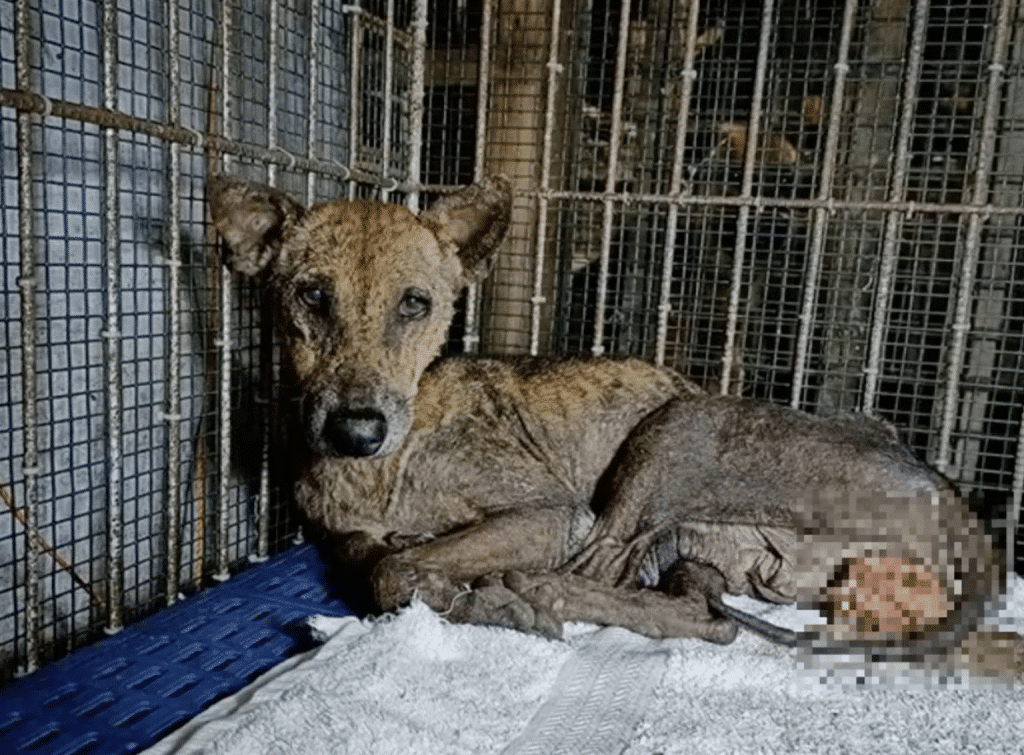
When the dog arrived, she was dehydrated, exhausted, and reluctant to eat.
Her caregivers provided a warm resting space and approached her gently.
They avoided overwhelming her with unnecessary interaction.
For several days, she remained withdrawn and showed little interest in her surroundings.
The team continued monitoring her while providing appropriate support.
Dehydration and weakness require careful attention, especially in animals that have recently experienced pregnancy-related complications.
Veterinary assessment can help determine whether an animal needs additional treatment, fluid support, or monitoring for reproductive health concerns.
The available account does not specify her complete medical findings or treatment plan.
It does describe a gradual recovery supported by warmth, food, and consistent care.
Her caregivers understood that progress might come slowly.
They gave her the time she needed.
The Morning She Finally Began Eating
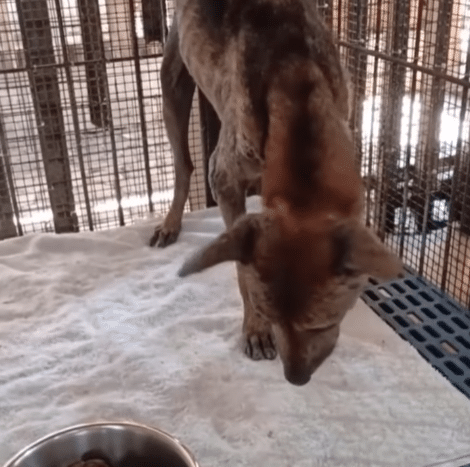
One morning, the dog approached her food bowl.
She paused briefly before beginning to eat.
For the people caring for her, this was an encouraging development.
Her appetite had been poor since arriving at the rescue center, making regular feeding an important concern.
Eating voluntarily can indicate improving comfort or interest in food, although it does not independently confirm that an animal has fully recovered.
Caregivers still need to monitor hydration, body condition, and other clinical signs.
For this dog, the moment represented a meaningful change in her daily behavior.
She was beginning to participate in her routine rather than remaining withdrawn.
The team continued offering food and allowing her to rest.
Small improvements gradually became more noticeable.
Recovery Happens Through Small Changes
As the days passed, the dog’s condition and behavior began improving.
She appeared more relaxed in her surroundings.
Her breathing became steadier, and she started accepting gentle contact from her caregivers.
Eventually, she gave a small wag of her tail.
It was a simple movement, but it showed a growing willingness to interact.
Dogs recovering from difficult experiences may need time to become comfortable with unfamiliar people.
Consistent routines, calm handling, and opportunities to choose whether to approach can help build confidence.
For this rescued female, trust developed gradually.
Her caregivers did not expect immediate affection.
They allowed her to become familiar with their presence and respond at her own pace.
Over time, the frightened dog they had found beside the road began showing more interest in the people around her.
Learning to Walk on a Leash
Several weeks after her rescue, the dog began walking on a leash.
Her first movements were cautious.
She needed time to become comfortable with the equipment and the experience of moving alongside a person.
Gradually, her steps became more confident.
Leash training can provide rescued dogs with a structured way to explore their surroundings while remaining safely connected to a caregiver.
For a dog previously found wandering near traffic, this skill has particular practical value.
Appropriate walking equipment, gentle encouragement, and short, positive sessions can help make the experience more comfortable.
The goal is not to force an animal into unfamiliar situations.
It is to build confidence through manageable experiences.
For this dog, walking on a leash became another milestone in her recovery.
The Importance of Care After Pregnancy Loss
The dog’s story also highlights the need for professional attention when a pregnant animal experiences an unexpected change in condition.
Pregnancy loss can occur for different reasons, and an animal may require veterinary evaluation afterward.
Potential concerns depend on the circumstances and may include dehydration, weakness, infection, or other reproductive complications.
Only a veterinarian can assess an individual dog’s condition and determine whether treatment is necessary.
Caregivers should avoid assuming that a dog is medically stable simply because she can walk or eat.
Continued monitoring remains important.
The original account does not establish the precise cause of this dog’s pregnancy loss or describe her full medical history.
Her documented recovery should therefore be understood through the improvements that were actually observed: renewed appetite, greater comfort, acceptance of gentle handling, and increased confidence during walks.
Why Patient Rescue Makes a Difference
This dog’s journey began with a single person noticing an exhausted animal beside a country road.
The first attempt to reach her was unsuccessful.
Rather than treating her disappearance as the end of the effort, volunteers continued searching.
When they found her again, they used food and distance to help her feel comfortable.
At the rescue center, caregivers supported her without demanding immediate interaction.
Each stage required a different kind of patience.
Sometimes rescue means acting quickly to remove an animal from immediate danger.
At other times, it means waiting quietly while a frightened dog decides whether to approach.
Both approaches can be essential.
The volunteers’ persistence helped create the conditions for this dog to receive the attention she needed.
A New Chapter Built on Trust
Weeks after her rescue, the dog’s daily life looked very different.
She was eating, accepting gentle affection, and walking with increasing confidence.
The account does not establish whether she was eventually adopted or where she would spend the rest of her life.
Nevertheless, the improvements described by her caregivers represent a meaningful change from her original circumstances.
She no longer had to navigate unfamiliar roads without anyone monitoring her condition.
She had people providing food, shelter, and patient support.
Her story shows that recovery is rarely a straight line.
Some days bring visible progress, while others require rest and continued observation.
For this dog, the most important development was the opportunity to recover in a protected environment.
Summary
A pregnant stray dog was first discovered lying exhausted beside a quiet country road.
After someone contacted rescuers, the team arrived to find that she had disappeared.
Volunteers searched the surrounding roads and fields for several days before locating her again.
By then, she was no longer pregnant and appeared thinner and weaker.
The rescuers approached carefully, offered food, and eventually transported her to a rescue center.
Initially dehydrated, exhausted, and reluctant to eat, she received warmth, shelter, and patient care.
Her recovery progressed gradually. She began eating voluntarily, accepted gentle human contact, wagged her tail, and eventually learned to walk on a leash.
Although her long-term outcome remains undocumented, her story demonstrates the value of persistent rescue efforts, responsible veterinary attention, and compassionate rehabilitation.
What began with a worried call about a vulnerable dog became a journey toward greater comfort, confidence, and safety.
Sometimes, the most meaningful change begins when someone notices an animal in need and refuses to stop looking.






