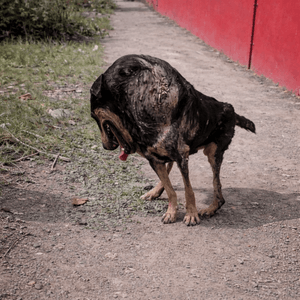
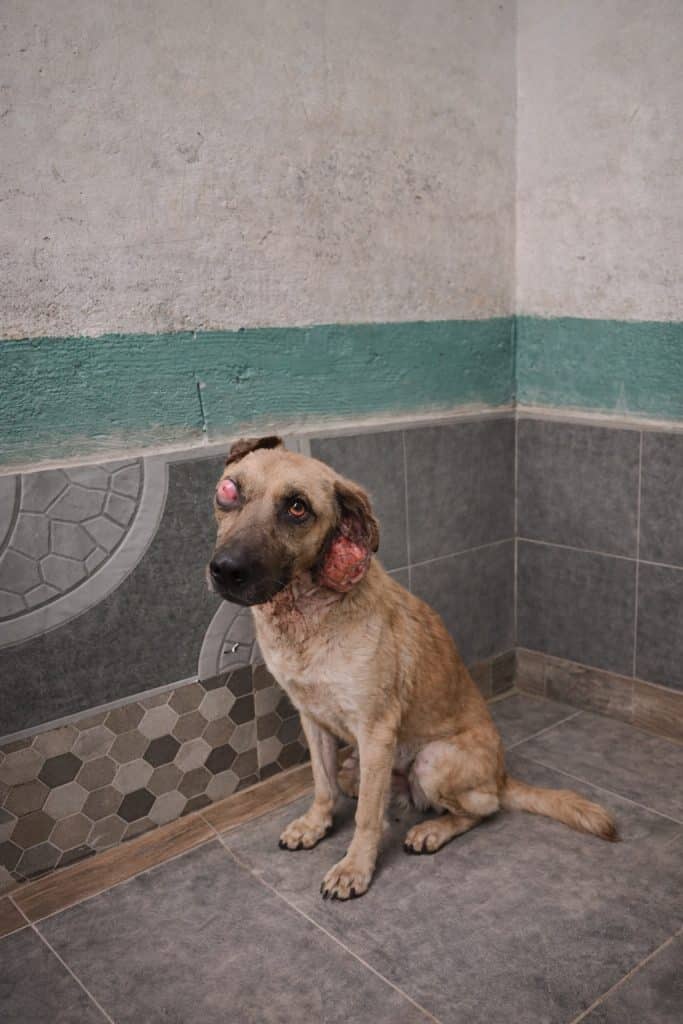
Life on the streets can challenge even the strongest dog. Finding food, clean water, shelter, and a safe place to sleep becomes a daily task. For one frightened stray, however, survival had become even more difficult because of a large growth along the side of his neck.
The swelling had changed the shape of his face and appeared to interfere with normal movement. One eye was also visibly affected, making his situation especially concerning. Thin and exhausted, the dog avoided people and sought refuge in quiet places where he could remain unnoticed.
He could not explain what was wrong or ask someone to take him to a veterinarian.
His future depended on somebody noticing him.
Video Living With Pain in Silence, This Stray Dog Faced a Battle No One Should Fight Alone
Residents Spot a Dog Who Clearly Needs Help
Local residents eventually became aware of the stray and reported his condition.
That decision proved important.
According to the rescue account, a team from Planet Strays responded and began searching for him. The journey was not simple. Rescuers traveled through rough, hilly terrain after dark, knowing that a frightened stray might move or hide before they arrived.
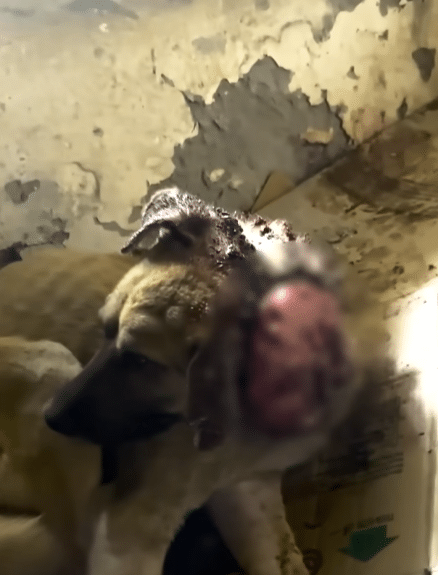
Eventually, they located him inside an abandoned building filled with discarded items.
The dog had curled himself into the dark surroundings, apparently choosing a place where he could avoid attention.
Finding him was one challenge.
Getting close enough to help was another.
A Careful Nighttime Rescue Begins
When rescuers approached, the dog backed farther into a corner.
His reaction was understandable. He did not know these people or understand why they were coming toward him. From his perspective, unfamiliar humans entering his hiding place could easily feel threatening.
The team therefore needed to protect both the dog and themselves.
Rather than attempting to grab him directly, they used specialized rescue equipment to secure him safely. A rescue net allowed the team to control the situation while reducing the risk of the frightened dog escaping into the darkness.
Soon, the animal who had been hiding alone was on his way to professional medical care.
It was an important turning point, but nobody yet knew exactly what treatment he would need.
A Simple Meal Marks the Beginning of Care
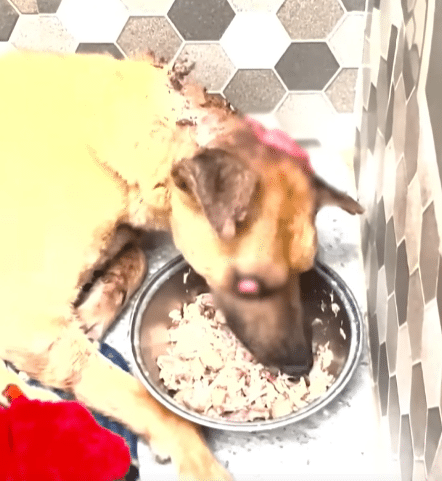
At the clinic, one of the first things the dog received was something wonderfully ordinary: food.
For a thin stray accustomed to uncertainty, a proper meal represented more than nutrition. It was the beginning of a completely different routine.
There was food available.
There were people paying attention.
There was a protected place to rest.
The veterinary team could now begin assessing his condition in a controlled environment.
The dog gradually became calmer as the immediate pressure of surviving outdoors disappeared. After eating and settling down, he finally had the opportunity to rest while professionals started working to understand the growth affecting his neck and face.
Veterinarians Search for Answers
A large mass cannot be understood through appearance alone.
Veterinarians therefore began a careful diagnostic process, including examinations, X-rays, and additional testing described in the rescue account.
The purpose was not simply to confirm that a growth existed. The medical team needed information that could help them understand its nature, its relationship to surrounding structures, and what treatment options might be appropriate.
Cases involving significant masses can require careful planning.
Surgery may sometimes be considered, but whether an operation is appropriate depends on many factors that only veterinary professionals can evaluate. An animal’s overall health, the location of a mass, diagnostic findings, and other medical considerations can all influence treatment decisions.
For this stray, there was no responsible shortcut.
The team needed to understand the problem before deciding how best to address it.
Rest Becomes Part of the Treatment
After the initial examinations, something quietly encouraging happened.
The dog slept.
It may sound like an insignificant detail, but comfortable rest can be difficult for an animal living outdoors while dealing with physical discomfort and uncertainty.
At the clinic, he no longer needed to search for somewhere to hide.
He did not need to watch constantly for approaching people.
Food was available, and professionals were monitoring his condition.
For a while, he could simply close his eyes.
The medical challenge had not disappeared, but one major part of his life had already changed.
He was no longer facing it alone.
A Long-Term Care Plan Takes Shape
The veterinary team recognized that recovery would require more than a single visit.
According to the account, supportive care included pain management, nutritional assistance, and continued monitoring while the team considered future treatment.
These measures helped create a more stable foundation for whatever came next.
Nutrition was particularly important because the dog had arrived thin and physically depleted. Supporting his general condition could help prepare him for additional treatment if veterinarians determined that further intervention was appropriate.
Progress was measured carefully.
A calmer period of rest mattered.
Steadier breathing mattered.
Accepting gentle contact mattered.
Not every improvement needed to be dramatic to be meaningful.
Trust Develops Through Repeated Experiences
The dog’s physical condition naturally attracted attention, but his behavior told another important part of the story.
When rescuers first discovered him, he tried to retreat into a corner.
At the clinic, that defensive distance gradually began changing.
Why?
Trust rarely appears because of one kind gesture.
It grows through repetition.
Food arrives, and nothing frightening follows.
A caregiver approaches calmly and then gives the animal space.
An examination ends, and the dog returns to a comfortable resting area.
Day after day, predictable experiences can help an anxious animal learn that the environment around him has changed.
For this stray, gentle handling and consistent care gradually replaced some of the uncertainty that had defined his life outside.
Why Professional Veterinary Evaluation Matters
A visible growth on an animal can naturally cause concern, but appearance alone cannot provide a diagnosis.
Different medical conditions can produce lumps or swelling, and treatment varies depending on the underlying cause.
That is why professional veterinary assessment is essential.
Diagnostic imaging, laboratory testing, physical examinations, and other procedures may help veterinarians build a clearer picture before recommending treatment.
The same principle applies when members of the public encounter stray animals with unusual physical conditions.
Trying to diagnose or treat a serious problem without professional guidance can create additional risks.
When possible, contacting a veterinarian, established rescue organization, or local animal welfare service is a safer way to begin.
Compassion gets someone’s attention.
Professional care helps determine what that animal actually needs.
Rescue Is Often a Process, Not a Single Moment
It is easy to imagine animal rescue as one dramatic event.
Someone finds a dog.
The dog enters a vehicle.
The rescue is complete.
In reality, that moment may only open the door.
The work afterward can include veterinary examinations, medication, nutritional support, safe housing, behavioral adjustment, follow-up appointments, and decisions about longer-term care.
This dog’s journey illustrates that reality clearly.
Removing him from the abandoned building was essential, but it did not solve his medical condition.
The rescue team and veterinary professionals still had a complicated road ahead.
Their commitment meant continuing even after the most visible rescue moment had passed.
A Future Built Around Careful Hope
The source account does not provide a final medical outcome, so it would be premature to promise exactly what will happen next.
What it does establish is that the dog is now receiving professional attention.
The medical team can monitor him.
He can eat regularly.
His discomfort can be managed appropriately.
Further treatment can be considered based on diagnostic findings rather than guesswork.
Those changes matter.
Hope does not require pretending that a difficult medical condition is simple.
Sometimes hope means having qualified people willing to investigate the problem, develop a plan, and continue providing care one day at a time.
From Hiding in Darkness to Resting in Safety
Perhaps the most striking contrast in this dog’s journey is not physical at all.
When rescuers found him, he was hiding inside an abandoned building and retreating from anyone who came near.
Later, after receiving food and veterinary attention, he was able to sleep in a protected environment.
The medical challenge remained.
But his circumstances had fundamentally changed.
He had been noticed.
He had been brought to safety.
And people were now working to understand how they could help him.
For an animal that once tried to disappear into a dark corner, being seen became the beginning of something better.
Summary
A thin stray dog was discovered with a large growth along the side of his neck that had noticeably altered the shape of his face and affected one of his eyes. Frightened and exhausted, he avoided people and eventually hid inside an abandoned building.
After local residents reported him, rescuers from Planet Strays traveled through difficult terrain at night and located the dog. Because he was fearful and retreating into a corner, specialized rescue equipment was used to secure him safely before transporting him for veterinary care.
At the clinic, he received food, rest, and a detailed medical evaluation. Veterinarians used examinations, X-rays, and diagnostic testing to better understand the growth and consider appropriate treatment options.
His ongoing care included nutritional support, pain management, monitoring, and gentle handling. Small improvements, including calmer rest and greater acceptance of human contact, became meaningful signs of progress.
His final medical outcome remains uncertain in the source account, but one crucial part of his story has already changed. He is no longer hiding outside without assistance.
He is safe, receiving professional care, and surrounded by people willing to give him the time and attention his recovery requires.
Sometimes a second chance begins with something very simple: someone notices a life that has been overlooked and decides it deserves care.