Floods can transform familiar neighborhoods within hours. Roads disappear beneath moving water, fences collapse, household belongings drift away, and places that once felt safe become almost impossible to recognize.
During one such flood, rescue workers traveled by boat through what had previously been residential streets. Brown water covered the area, while damaged structures and floating debris created obstacles around every corner.
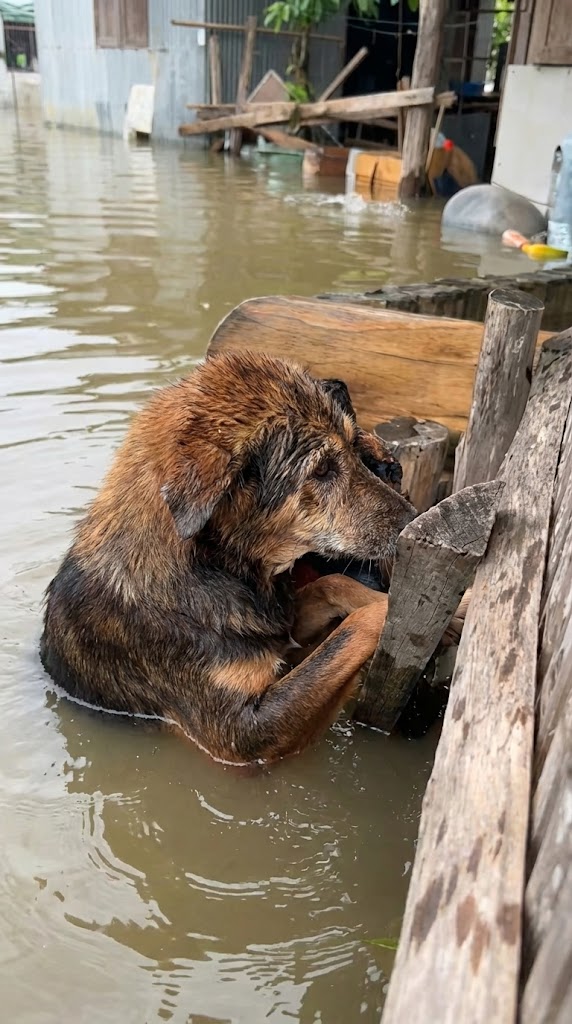
Then the team noticed something moving near a wooden barrier.
A small dog was pressed against the structure, struggling to remain above the water.
The rescuers had gone out searching for survivors.
They had just found one.
Video Between the Rising Tides and a Hidden Burden The Incredible Survival of a Flood-Strand Soul
A Dog Trapped in the Current
The dog appeared exhausted.
The force of the water had pushed him tightly against pieces of wood, leaving him with little room to escape. Whenever he attempted to move, the current worked against him.
For rescuers, the challenge was reaching him without creating additional danger.
Floodwater can be unpredictable. Currents may shift quickly, and submerged debris can make even a short rescue complicated.
The team therefore approached carefully from their boat.
Instead of immediately reaching toward the frightened dog, they used a wooden oar to create enough space between the pieces of debris surrounding him.
Slowly, an opening appeared.
The dog made his move.
Using what strength remained, he pulled away from the barrier and began swimming toward the rescue boat.
Hands reached down and lifted him from the water.
He was soaked and visibly exhausted, but he was finally out of the current.
A Safe Boat Becomes the First Step
For the dog, simply reaching the boat represented an enormous change.
Only moments earlier, nearly all of his energy had been focused on staying above the water.
Now he could stop swimming.
He could rest.
And, most importantly, people could finally examine him more closely.
After being transported away from the flooded area, the dog arrived at an emergency rescue location where volunteers began drying him and checking his overall condition.
That was when they noticed something unexpected.
His body did not appear normal beneath the wet fur.
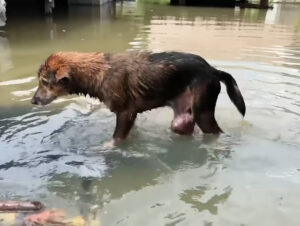
There seemed to be a substantial mass near his abdomen.
The flood rescue had solved one immediate emergency.
Now another problem required attention.
Veterinary Care Reveals a Hidden Medical Concern
A veterinary examination confirmed the presence of a large growth near the dog’s abdominal area.
According to the rescue account, the mass was substantial and required further medical attention.
It may also have contributed to the difficulty the dog experienced while moving through the floodwater.
However, appearance alone cannot determine exactly what a growth is, how long it has been present, or how it should be treated. Those questions require professional veterinary evaluation.
For the rescue team, the discovery changed the direction of the dog’s care.
He no longer needed assistance only because he had survived a natural disaster.
He also needed treatment for a medical condition that might otherwise have remained unnoticed.
The flood had brought him into contact with people capable of helping.
Now they had to decide what came next.
From Emergency Rescue to Medical Treatment
According to the account, veterinarians determined that the growth required surgical treatment.
Preparing a recently rescued animal for a procedure requires careful professional judgment. The dog’s overall condition had to be considered alongside the medical issue itself.
He had already endured the stress of the flood and a difficult rescue.
Now his veterinary team faced another challenge.
The surgery proceeded, and the large mass was successfully removed, according to the story.
For the dog, this marked the second major turning point in a remarkably short period.
First, rescuers had freed him from the flooded neighborhood.
Then veterinary professionals addressed the physical burden discovered after he reached safety.
The two events were very different, but both depended on people recognizing that rescue does not always end when an animal leaves immediate danger.
Sometimes that is only where recovery begins.
Rest Becomes Part of the Rescue
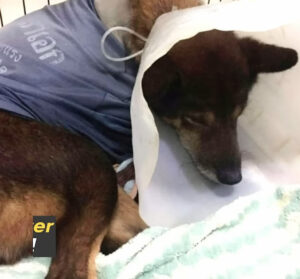
After surgery, the dog entered a quieter phase of his journey.
There was no rushing current.
No floating debris.
No need to struggle toward a boat.
Instead, there was rest.
He could eat in a protected environment, sleep without searching for higher ground, and receive continued monitoring while his body recovered.
These ordinary moments often receive less attention than the dramatic rescue itself, yet they are essential.
An animal may be pulled from danger in minutes.
Recovery can take days, weeks, or longer.
Safe shelter, suitable nutrition, veterinary follow-up, medication when prescribed, and patient caregivers all contribute to what happens after the cameras stop recording.
For this dog, surviving the flood opened the door to that longer process.
Why Disaster Animal Rescue Matters
Natural disasters affect more than people and buildings.
Pets, stray animals, livestock, and wildlife may all become displaced when familiar environments suddenly disappear beneath water or are damaged by storms.
Dogs can become separated from their families during evacuations. Strays may lose familiar feeding areas and places where they normally shelter.
Flooding creates additional hazards because animals can become trapped by fences, structures, debris, or strong currents.
That is why trained rescue teams can play such an important role during emergencies.
Floodwater may contain hidden obstacles and other hazards, so attempting a dangerous rescue without appropriate experience or equipment can place both people and animals at greater risk.
When possible, contacting emergency services or trained animal rescue organizations is the safer approach.
Compassion matters, but effective rescue also requires judgment.
A Disaster Can Reveal Other Needs
This dog’s experience illustrates another reality of animal rescue.
The most visible emergency is not always the only problem.
Once an animal reaches safety, caregivers may discover dehydration, exhaustion, chronic medical conditions, mobility problems, or other issues that were difficult to notice from a distance.
That is why post-rescue veterinary assessment can be valuable.
A dog pulled from floodwater may look relatively stable while still requiring professional evaluation.
In this case, the examination reportedly revealed a large mass that required medical treatment.
Without the flood rescue, there is no way to know when the condition would have received attention.
A frightening event unexpectedly became the path that connected the dog with veterinary care.
Rescue Is More Than One Heroic Moment
We often picture rescue as a single dramatic scene.
A boat arrives.
Someone reaches down.
The animal is lifted aboard.
Everyone celebrates.
But real rescue can be more like a bridge than a single step.
Getting an animal out of immediate danger is one side of that bridge. The other side includes veterinary care, rehabilitation, safe housing, identification efforts, and sometimes the search for a permanent family.
This dog’s story moved through several stages.
He had to be noticed in the water.
The rescuers had to reach him.
They had to free him from the barrier.
He needed transportation to safety.
Volunteers then had to recognize the unusual mass.
Veterinarians had to evaluate it.
Treatment followed.
Each step depended on the one before it.
That is what makes coordinated animal rescue so valuable.
What Comes Next for a Flood Survivor?
The account describes the dog recovering safely at a rescue station following treatment.
His immediate circumstances have changed dramatically.
Instead of fighting a current, he can rest.
Instead of carrying an untreated growth without professional attention, he has received veterinary care.
One question remains unanswered.
Did he have a family before the flood?
Disasters can separate pets from their owners, so identification efforts are an important part of many animal rescue operations. Microchip scans, photographs, local lost-pet notices, and coordination with shelters can sometimes help reunite displaced animals with their families.
If no previous caregiver can be located, adoption may eventually become another possibility once the animal is medically ready.
The source story does not provide a final answer.
For now, recovery comes first.
A Second Chance Built on Many Acts of Care
It would be easy to describe this story as one lucky rescue.
In reality, luck alone does not explain what happened.
Someone noticed the dog.
A rescue team maneuvered through the flooded neighborhood.
People worked carefully to free him.
Volunteers examined him after he reached safety.
Veterinary professionals investigated the newly discovered medical concern.
Treatment followed.
Each action created another opportunity.
The dog did his part too.
Despite exhaustion, he used his remaining strength to swim toward the boat once rescuers created an opening.
That moment connected him with everything that came afterward.
The flood may have changed his surroundings in an instant, but compassion changed the direction of his future.
Summary
During a serious flood, rescue workers navigating a submerged neighborhood discovered a dog trapped against a wooden barrier by the current. The team carefully used an oar to create an opening, allowing the exhausted animal to swim toward their boat before they lifted him to safety.
At an emergency shelter, volunteers noticed an unusual mass near his abdomen. A veterinary examination confirmed a large growth that required further treatment.
According to the rescue account, veterinarians eventually removed the mass surgically, giving the dog an opportunity to recover from both the flood and an unexpected medical condition.
He now rests in a protected rescue environment while his recovery continues. Whether he will eventually reunite with a previous family or begin life in a new home remains unknown.
His experience offers an important reminder: rescue rarely ends when immediate danger disappears. Sometimes saving an animal from one crisis reveals another need waiting underneath.
From the flooded streets to veterinary care and quiet recovery, this dog’s journey shows what coordinated compassion can accomplish. One rescue boat removed him from the water, but the people who continued caring afterward gave him something equally valuable: the opportunity to begin again.