The forest seemed unusually quiet that morning.
A man walking along a narrow woodland trail suddenly heard a distressed cry somewhere beyond the trees. Instead of continuing on his way, he stopped and listened.
The sound came again.
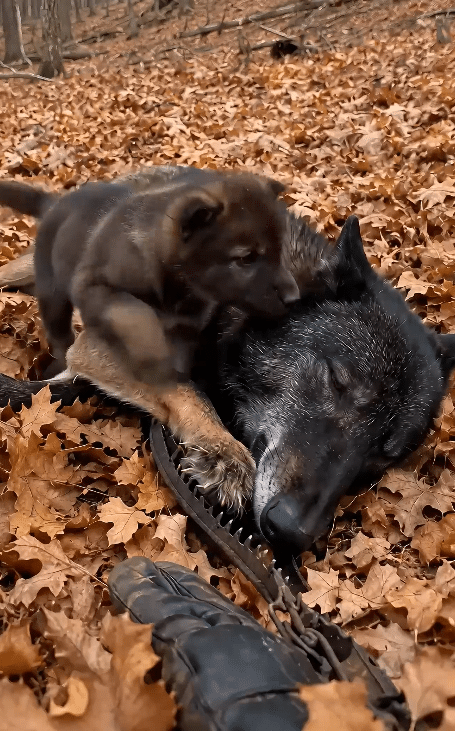
He followed it deeper into the woods until he discovered something he could not simply ignore. A mother wolf was caught by one leg in a steel trap. She appeared exhausted and frightened, unable to free herself.
But she was not alone.
Video A Mother Wolf Was Trapped and Too Weak to Stand Months Later, Her Grown Cub Returned
A young cub stood beside her.
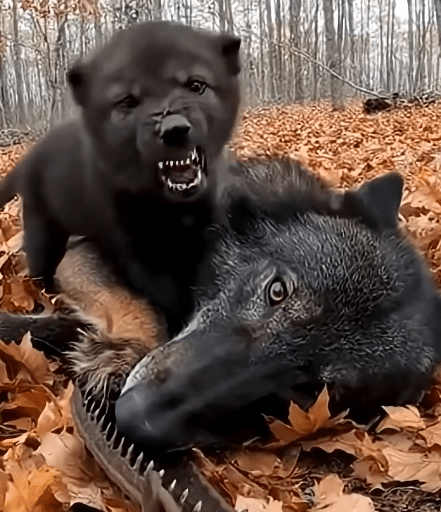
Small and clearly outmatched by the situation, the cub nevertheless placed himself between his mother and the approaching stranger. He could not realistically protect her from an adult human, yet instinct told him to try.
The man immediately understood that helping the mother would require patience. Before he could reach the trap, he needed to convince her frightened cub that he was not another danger.
A Young Cub Refuses to Leave His Mother
As the stranger moved closer, the cub lowered his body and growled.
He watched every movement.
Rather than forcing his way forward, the man stopped. He lowered himself toward the ground, kept his movements slow, and spoke quietly.
Minutes passed.
The cub remained cautious.
Nothing about the situation guaranteed that a wild animal would accept human presence, so the man avoided rushing the interaction.
Gradually, the cub became less defensive and moved far enough away for the rescuer to approach the trapped mother.
It was only a small amount of space.
But it was enough.
The difficult work could finally begin.
Freeing the Mother Requires Patience
The steel trap held the mother’s leg tightly.
Repeated attempts to escape appeared to have left her exhausted, and she no longer had enough strength to simply pull herself free.
The man approached cautiously and began working on the trap.
Whenever either wolf became noticeably uneasy, he slowed down.
The cub stayed nearby throughout the process, unwilling to wander far from his mother.
Eventually, the mechanism opened.
Her leg was free.
For one hopeful moment, it might have seemed that the rescue was complete.
Then the mother tried to move.
She was unable to leave confidently and needed further assistance. Simply opening the trap would not provide the medical attention necessary for her injured leg.
The man therefore arranged to transport both wolves for professional veterinary care.
The cub went with his mother.
He had remained beside her in the forest, and now he continued accompanying her into an unfamiliar world.
Veterinary Care Becomes the Next Step
At the clinic, veterinary professionals examined the mother’s injured leg.
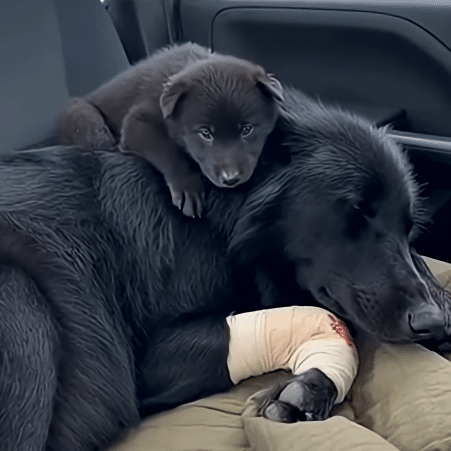
According to the account, the affected area was cleaned and treated, fresh bandaging was applied, and medication was provided to manage her discomfort and support recovery.
The cub remained nearby whenever circumstances allowed.
A veterinary clinic must have seemed completely foreign to both animals.
There were bright lights, unfamiliar scents, equipment, voices, and people moving around them.
Yet the mother and cub appeared most settled when they remained aware of each other’s presence.
That connection had helped them through the forest ordeal.
Now it became a source of familiarity during recovery.
The mother’s leg needed time to heal before she could safely return to her natural environment.
Freedom remained the goal.
First, however, she needed to become strong enough to handle it.
Wild Animals Need Respect, Not Domestication
The man continued caring for the wolves in a protected setting while the mother recovered.
Food and clean water were provided regularly.
She had a quiet place to rest without needing to travel in search of resources, while her cub remained nearby.
Importantly, the goal was not to turn the wolves into pets.
They were still wild animals.
That distinction matters whenever people encounter wildlife in distress.
Wild animals can react unpredictably when frightened, injured, or protecting their young. Attempting to handle them without appropriate experience can endanger both the animal and the person trying to help.
In real-world situations, contacting qualified wildlife professionals or appropriate local authorities is generally the safest approach.
Compassion does not require treating a wild animal like a domestic dog.
Sometimes the most respectful form of kindness is providing necessary assistance while preserving the animal’s natural independence.
Trust Develops Without Being Forced
During the recovery period, both wolves initially remained cautious around people.
The cub became alert whenever something unfamiliar happened.
His mother carefully watched anyone entering their space.
Their caregiver did not demand affection or attempt to force unnecessary interaction.
Instead, he created a predictable routine.
Food arrived.
Water remained available.
Necessary treatment continued.
The environment stayed calm.
Day after day, the wolves experienced human presence without an additional threat.
The cub gradually became more curious about his surroundings, while the mother’s leg continued improving.
This was not domestication.
It was simply a temporary relationship built around care.
The wolves did not need to become dependent on people.
They needed enough time and support to return to the forest.
The Mother’s Strength Gradually Returns
Recovery rarely happens in a single dramatic moment.
At first, improvement appeared through small changes.
The mother rested.
Then she became more comfortable placing weight on her recovering leg.
Her movement grew steadier.
As the weeks passed, she regained enough strength to move confidently again.
Eventually, the day everyone had been working toward arrived.
She was ready to return to the wild.
For the rescuer, this meant accepting an important truth about wildlife rehabilitation: success often ends with goodbye.
He had invested time and effort into helping the animals recover, but keeping them was never the purpose.
Their home was the forest.
The Day Mother and Cub Return to Freedom
The man transported the wolves back to the wilderness where they had been found.
This journey was very different from their first trip together.
The mother was no longer trapped and exhausted.
The cub was no longer standing beside a steel trap trying to protect her.
When the way into the forest opened, there were no ropes forcing them to remain nearby.
The cub moved toward the trees first.
Familiar scents and sounds surrounded him again.
The mother reportedly paused briefly before following.
Then both wolves disappeared into the woodland.
That was exactly what the rescuer had hoped would happen.
He had not helped them so they would remain with him.
He had helped them so they could leave.
Six Months Pass Without Another Encounter
Life continued.
The rescue became one of those extraordinary memories that can stay with someone long after the moment itself has ended.
Nearly six months passed.
Then, according to the account, a young wolf appeared near the edge of the man’s property.
He was larger now.
The small cub from the forest would have grown considerably during those months, and the rescuer believed the animal watching him from a distance was the same wolf.
Something about his behavior seemed familiar.
The young wolf approached cautiously while carrying a rabbit.
When he reached a certain point, he reportedly placed it on the ground and stepped away.
For a short time, human and wolf simply watched one another.
What Did the Wolf’s Return Really Mean?
It is tempting to describe the encounter as a thank-you gift.
It certainly makes an appealing interpretation.
But wildlife behavior deserves more careful treatment.
We cannot know exactly why the wolf approached, whether he understood the event as humans might understand gratitude, or what the rabbit represented to him.
It could have reflected natural behavior.
The wolf might have recognized the man or associated the area with previous experiences.
Perhaps he simply felt comfortable enough to approach.
Without scientific observation, assigning a specific human emotion or intention would be speculation.
And the story does not need that speculation to be meaningful.
The remarkable part is that a wild animal believed by the rescuer to be the same cub returned months after being released.
The wolf approached without obvious hostility, remained briefly, and then returned to the forest.
That moment can stand on its own.
Kindness Does Not Require Ownership
There is a powerful lesson hidden within the story.
The man helped without demanding anything in return.
He did not rescue the wolves so they would become companions.
He did not expect the cub to return.
He did not keep the animals once they were capable of surviving independently.
His responsibility ended where their freedom began.
That is an important principle in responsible wildlife care.
Wild animals belong in appropriate natural environments whenever safe rehabilitation and release are possible.
Helping them should protect that independence rather than replace it.
In this case, the greatest reward was not having two wolves stay nearby.
It was watching them disappear between the trees.
One Decision Changed the Direction of Two Lives
Everything began with a sound.
The man could have ignored the distant cry and continued walking.
Instead, he stopped.
He listened.
Then he followed.
That decision led him to a trapped mother and the cub refusing to abandon her.
Patience allowed him to approach.
Careful action freed the mother.
Veterinary treatment gave her an opportunity to recover.
Temporary protection allowed her leg to regain strength.
And release returned both animals to the place where they belonged.
Months later, an unexpected encounter appeared to connect the present with that morning in the forest.
Whether the young wolf returned because he remembered the rescuer cannot be known with certainty.
But perhaps certainty is not necessary.
Sometimes the most meaningful part of helping another living creature is knowing that you gave it the opportunity to walk away.
Summary
A man following a woodland trail heard a distressed cry and discovered a mother wolf caught by one leg in a steel trap. Her young cub remained beside her and initially reacted defensively toward the approaching stranger.
Rather than rushing forward, the man waited patiently until he could safely reach the trapped mother. He eventually released her, but she was too weak to return immediately to the forest.
The mother and cub were taken for veterinary care. Her injured leg received treatment, and both animals remained in a protected environment while she recovered.
Several weeks later, the mother regained enough strength to move confidently again. The man returned both wolves to the wilderness and allowed them to leave freely.
Nearly six months afterward, he reportedly encountered a young wolf that he believed was the same cub. The animal approached carrying a rabbit, left it nearby, and eventually disappeared into the trees.
We cannot know precisely what motivated the wolf’s behavior, and describing it definitively as gratitude would go beyond what the story establishes.
What remains clear is simpler and perhaps more powerful.
A person heard an animal in distress and chose not to walk away. He helped a mother recover, kept her cub beside her, and ultimately returned both animals to freedom.
Sometimes compassion does not end with keeping something close.
Sometimes its greatest success is watching it become strong enough to leave.






