Beneath an ordinary city street, a frightened dog was trapped inside a narrow concrete drainage pipe. The entrance offered the only visible way out, while the tunnel stretched horizontally into darkness.
From above, the opening looked like another forgotten part of the roadside infrastructure. But faint whimpers revealed that an animal was struggling somewhere inside.
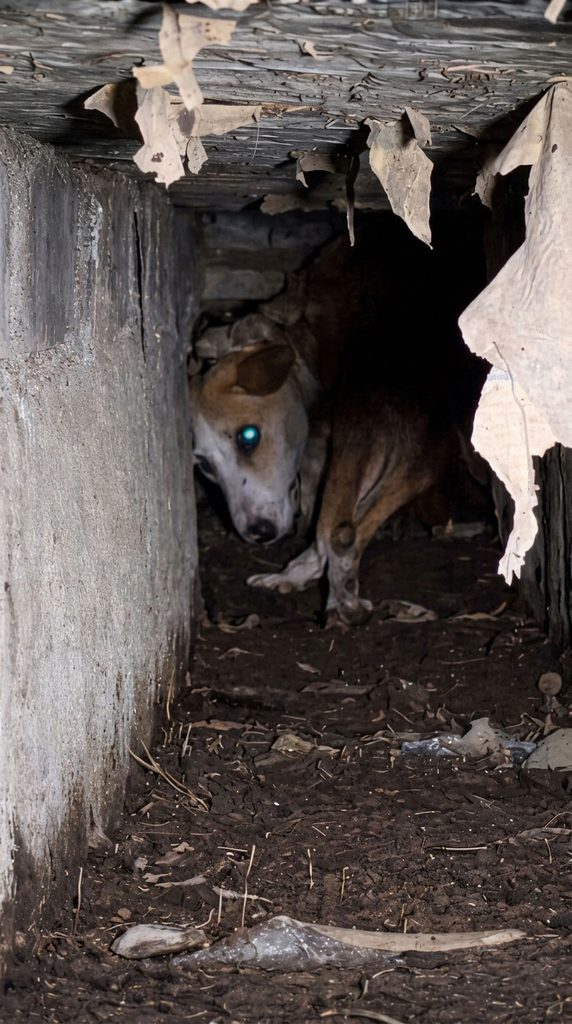
The dog was too far into the pipe for anyone to reach him from the surface. The confined space also made a conventional rescue difficult.
When volunteers from the Animal Warriors Conservation Society (AWCS) arrived, they faced a challenge that required patience, careful coordination, and a willingness to enter the narrow tunnel themselves.
Video A Faint Cry Echoed from the Pitch-Black Depths of a Dry Concrete Trap
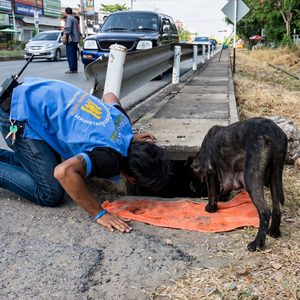
One rescuer crawled into the drainage pipe to reach the frightened animal. With a rescue rope, gentle encouragement, and food placed near the opening, the team eventually guided him back toward daylight.
What began as a difficult underground rescue ended with the dog safely outside, wrapped in a blanket, and receiving the care he needed.
A Faint Cry From Beneath the Road
The rescue began after the dog’s weak cries drew attention to an underground drainage opening.
The surrounding street appeared ordinary, but the animal was hidden deep inside a dry, horizontal concrete pipe.
Only one accessible opening connected the tunnel to the surface.
For the dog, that meant there was no obvious alternative route to safety.
He remained inside the dark passage while his calls became increasingly difficult to hear.
Underground drainage structures can create serious challenges for trapped animals. Their narrow dimensions restrict movement, while limited access makes it difficult for rescuers to assess the situation.
The AWCS team arrived with flashlights and began examining the opening.
Their lights revealed the frightened dog farther inside the tunnel.
He was alive, but reaching him would require more than simply lowering a hand into the drain.
A Rescue That Required Entering the Tunnel
The pipe’s horizontal design prevented the volunteers from reaching the dog directly from above.
There was insufficient room for several people to work inside simultaneously, and the animal remained beyond easy reach.
One volunteer decided to enter the tunnel.
He lowered himself through the opening and carefully moved into the confined passage.
Crawling along the rough concrete required slow, deliberate movements.
The rescuer also needed to avoid frightening the dog, who could retreat farther into the tunnel if approached too quickly.
Confined-space rescues present risks to both animals and people.
Restricted movement, poor visibility, and limited access can complicate even a seemingly straightforward operation.
Such situations are best handled by trained rescuers who can assess the environment and choose suitable equipment.
In this case, the AWCS volunteer continued moving carefully until he could reach the dog.
Reaching a Frightened Animal in the Darkness
The dog remained cautious as the rescuer approached.
His reaction was understandable.
He was inside an unfamiliar, restrictive environment, and a person was moving toward him through the narrow passage.
Even animals that normally enjoy human contact may behave differently when frightened or trapped.
The volunteer avoided sudden movements and worked to secure the dog without forcing him through the tunnel.
Eventually, he managed to position a rescue rope around the animal.
The rope provided the team with a way to maintain control and assist the dog during the next stage.
However, securing the rope did not mean the rescue was finished.
The dog still needed to move toward the opening.
The rescuer then began crawling backward toward the surface, carefully navigating the confined space.
Once outside, the volunteers considered how to encourage the frightened dog to follow.
Food Becomes the Key to a Gentle Rescue
Rather than immediately pulling the dog through the pipe, the team chose a more patient approach.
They placed small pieces of appealing food near the opening.
The scent gave the dog a reason to move toward the surface voluntarily.
This approach allowed the volunteers to encourage him without relying entirely on physical force.
Food can be useful during certain animal rescues because it creates a positive incentive for a frightened animal to approach.
However, its effectiveness depends on the animal’s condition and the surrounding environment.
A dog experiencing severe fear, illness, or injury may not respond to food immediately.
The AWCS team gave the animal time.
Gradually, he began moving toward the entrance.
His progress was slow, but every movement brought him closer to safety.
The volunteers remained nearby, ready to assist once he reached the accessible part of the drain.
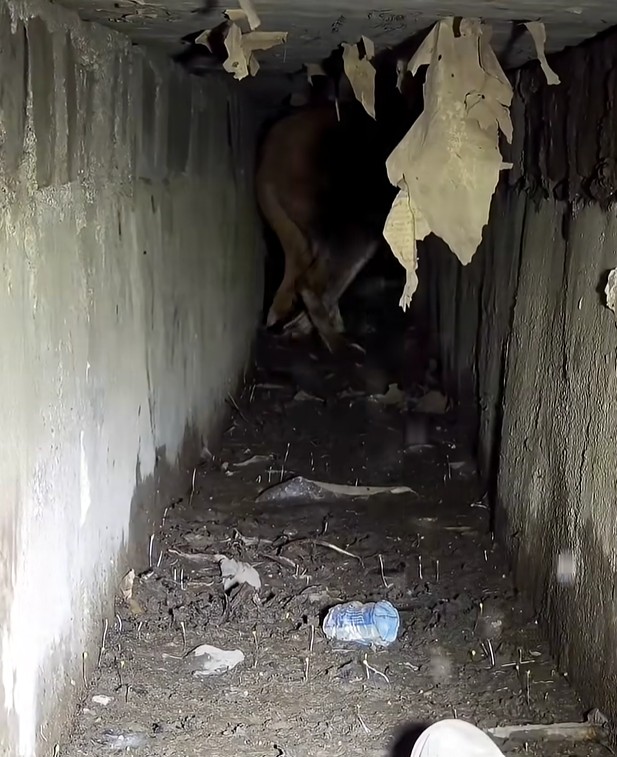
The Final Moments Inside the Concrete Pipe
After moving through the tunnel, the dog finally approached the opening.
His dusty paws reached the edge, allowing the rescuers to assist him out of the confined space.
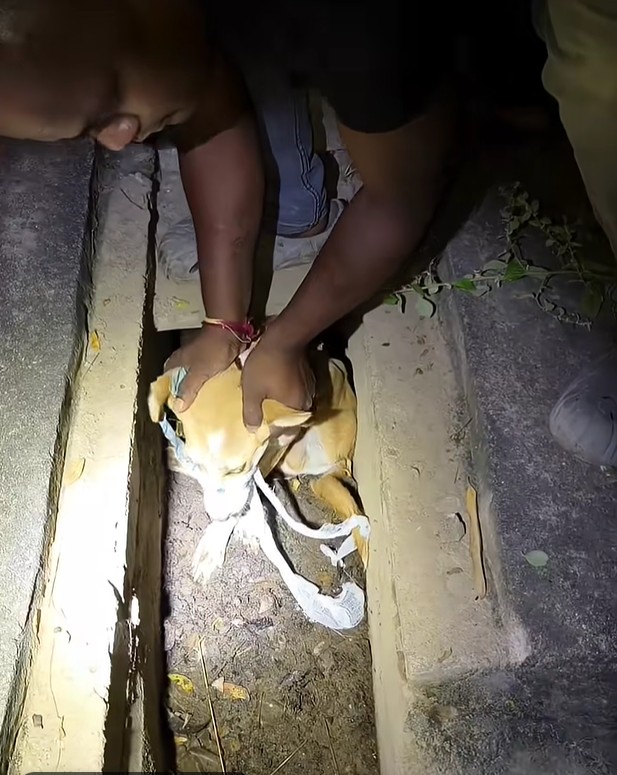
The team carefully lifted him into the open air.
The difficult part of the rescue was finally over.
For an animal that had been hidden deep inside an underground passage, reaching the surface represented an immediate improvement in his circumstances.
He was no longer restricted by the concrete walls.
The volunteers could now observe him more easily and provide attention without the obstacles created by the tunnel.
The rescue account describes the dog as exhausted after the ordeal.
He needed time to rest and recover from the experience.
A Blanket and a Moment of Comfort
Once outside, the volunteers wrapped the dog in a soft blanket.
He rested on the pavement while the team remained close.
The blanket provided a more comfortable resting surface and helped protect him from the surrounding environment.
The dog appeared tired after his time underground.
His body language became calmer as the immediate danger passed.
The account also describes him resting his head against a rescuer’s arm.
It was a quiet moment following a physically demanding operation.
Although we cannot know exactly what the dog was feeling, the change in his circumstances was clear.
He had moved from a dark, inaccessible pipe into an open space where people could attend to his needs.
The volunteers had successfully completed the extraction.
The next priority was ensuring that he remained safe.
Securing the Drainage Opening
The rescue team did not leave the site immediately after removing the dog.
They also addressed the opening that had allowed him to become trapped.
According to the account, the volunteers secured a heavy cover over the accessible entrance.
This action was intended to prevent another animal from entering the same hazardous space.
The precaution highlights an important aspect of responsible rescue work.
Removing an animal from danger solves the immediate problem, but addressing the environmental hazard may help prevent similar incidents.
Open drainage systems, uncovered utility spaces, and damaged roadside structures can present risks to animals and pedestrians.
When a hazardous opening is discovered, notifying the appropriate local authority is an important step.
Qualified personnel should assess and secure infrastructure while preserving any drainage, ventilation, or maintenance requirements.
In this case, the team took action to close the exposed entrance after completing the rescue.
Why Underground Animal Rescues Require Special Care
Rescuing an animal from a confined space involves more than locating and removing it.
The environment itself can create additional hazards.
Narrow tunnels restrict access, reduce visibility, and make communication difficult.
Some drainage systems may also contain unsafe air, unstable materials, or unexpected water flow.
For these reasons, members of the public should avoid entering underground drains or confined infrastructure without appropriate training and equipment.
If an animal becomes trapped, contacting an experienced rescue organization or emergency service is generally the safer option.
Providing the animal’s exact location and describing the accessible openings can help responders prepare.
It is also important to avoid forcing a frightened animal deeper into a passage.
The AWCS rescue demonstrated the value of careful planning and controlled movements.
The team combined direct access with a gentle method of encouraging the dog toward the exit.
Their approach helped bring him out without an unnecessarily forceful extraction.
Recovery Begins After the Rescue
The account states that the dog was subsequently placed in a warm shelter environment to recover.
After a stressful incident, an animal may need rest, hydration, food, and appropriate veterinary assessment.
A dog found inside a drainage pipe may also benefit from an examination for dehydration, injuries, respiratory concerns, or other complications.
The exact medical findings and long-term recovery details are not provided in the source account.
Therefore, the documented outcome is that the dog was successfully removed and brought into a protected environment.
His condition would still need monitoring.
A quiet resting area and gentle handling can help a frightened animal settle after rescue.
Caregivers should also allow the dog time to become comfortable rather than overwhelming him with attention.
Recovery is not always immediate, even when an animal has escaped the original danger.
The Importance of Community Animal Rescue
The dog’s experience illustrates the challenges that rescue organizations encounter in urban environments.
Stray animals may become trapped in drainage systems, construction areas, abandoned buildings, or other places that are difficult to access.
Some incidents require specialized equipment.
Others depend on patience, careful handling, and an understanding of animal behavior.
The Animal Warriors Conservation Society’s response brought these elements together.
One volunteer entered the pipe, while the remaining team coordinated the extraction from above.
Food helped encourage the dog toward the opening.
The volunteers then assisted him out and secured the exposed entrance.
Each action contributed to the outcome.
The rescue also demonstrates why community awareness matters.
An animal hidden beneath a street may remain unnoticed unless someone hears its calls or recognizes that something is wrong.
Reporting such situations to an experienced organization can create an opportunity for timely assistance.
A Second Chance Beyond the Darkness
By the end of the operation, the dog was no longer trapped beneath the road.
He had reached the surface, received comfort from the rescuers, and entered a safer environment.
The account does not establish his eventual adoption status or provide a detailed long-term medical update.
Nevertheless, the immediate rescue was successful.
The team had located an animal in a difficult position, reached him through a narrow passage, and brought him out using a controlled approach.
They also took steps to address the hazardous opening.
The story offers a reminder that animal welfare involves both immediate intervention and prevention.
Helping one dog matters.
Reducing the risk of another animal entering the same dangerous location matters too.
Summary
A frightened dog became trapped deep inside a narrow, horizontal drainage pipe beneath a street in Hyderabad.
After hearing his weak cries, rescuers from the Animal Warriors Conservation Society arrived and located him using flashlights.
Because the tunnel had only one accessible opening, a volunteer crawled inside and carefully secured a rescue rope around the dog.
The team then used food to encourage him toward the entrance rather than relying entirely on force.
Once the dog reached the opening, rescuers lifted him to safety and wrapped him in a blanket.
They also secured the exposed drainage entrance to reduce the risk of another animal becoming trapped.
The dog was subsequently brought into a protected shelter environment to recover.
His journey highlights the importance of trained rescue teams, patient animal handling, and attention to environmental hazards.
What began with a faint cry beneath an ordinary street ended with a vulnerable dog receiving the care and safety he needed.